
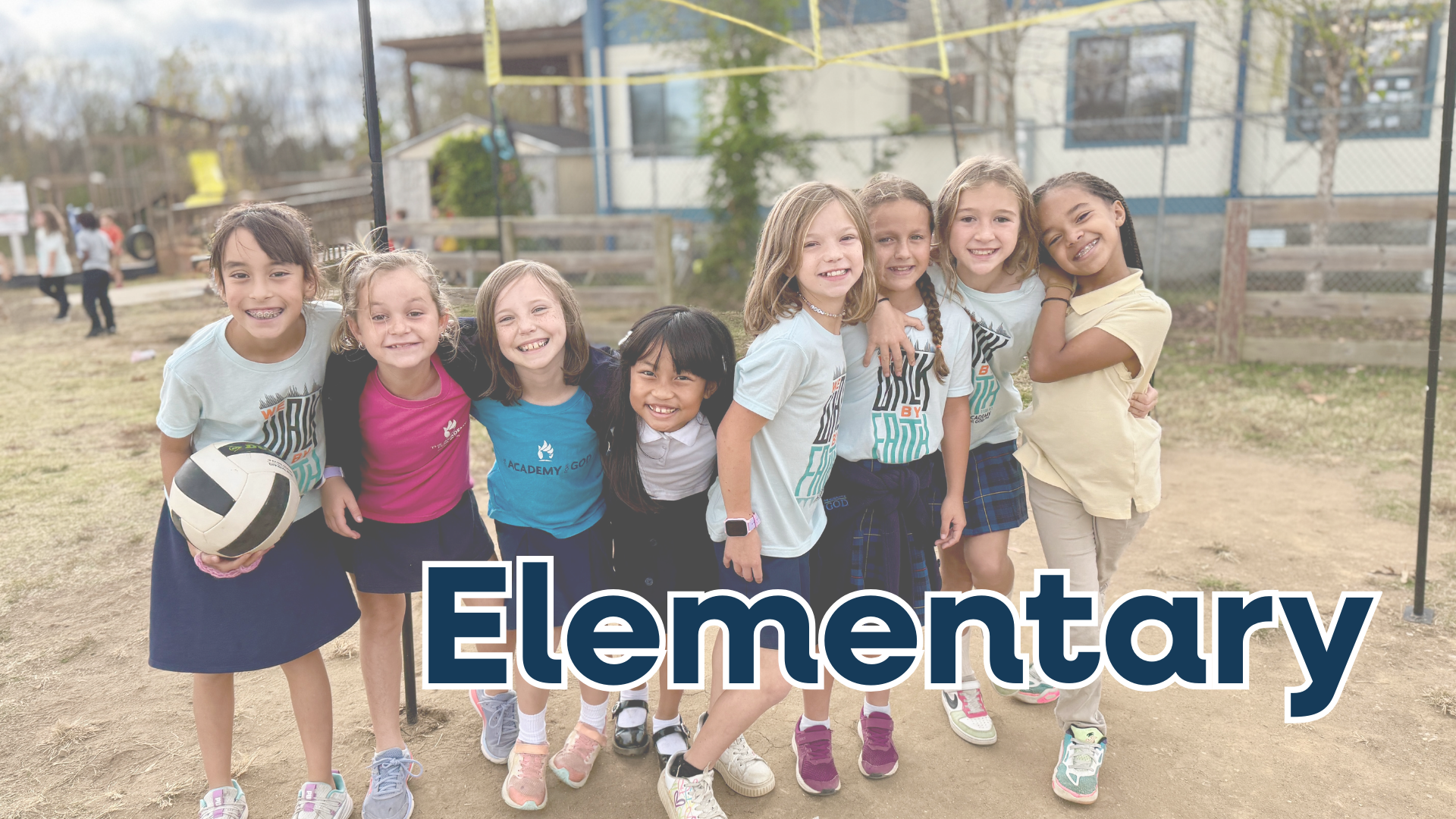
At The Academy for GOD students participate in our elementary program from Kindergarten through sixth grade. The following distinctives are the main academic ways in which we teach our students over the course of their most fluid developmental: a framework that includes our five areas of holistic education (academic, emotional, social, ethical, and spiritual), fluid course schedules, interaction with a variety of teachers, no mandatory homework, no letter grades, and more.

Elementary Distinctives

Lead & Course Teachers
Students at the elementary level interact with both lead teachers and course teachers on a daily basis.
Lead Teachers act as the manager of their class/classroom and are responsible for observing and encouraging the overall holistic education of the students in their class, including the academic, social, emotional, spiritual, and ethical. Each student is placed in one classroom with similarly aged peers with one lead teacher. Lead teachers also teach courses within their area of expertise.
Course Teachers are responsible for coming into the classroom and teaching a specific set of academic content within one discipline (Language Arts, Creative Arts, or STEM). For example, a farmer may partner with us at the Academy and come in to teach garden classes for our students. Course teachers are responsible to communicate with Lead Teachers to ensure the overall philosophy of the Academy is in tact.
No Mandatory Homework
At the elementary level, students will be assigned homework in Language Arts and Bible classes. While it is highly recommended, it is not mandatory. Students are offered incentives to complete the work, but are not penalized for not completing homework assignments. Assignments are meant to assist in their learning process and give them more opportunities with the content learned in class. It is not meant to function as the main assessment of how a student is progressing with content.

No Letter Grades (for assignments or courses)
At the elementary level students do not receive letter grades for their assignments or their courses. The reason why students don’t receive grades is because it’s been my (Mr. Garner’s) observation (and study) that most children are not able to differentiate between their work being graded and their person being graded. For example, a 4th grader can get a C- on an assignment (where they are told the C- means below average), and unfortunately, many come to believe that they are below average, as a person. Or at least that they are below average when it comes to that particular subject matter. This is of course a misconception, but the labeling becomes difficult to compute for a mind that has yet to develop the cognitive capacity for making abstract connections. It’s for this reason that our elementary students do not receive letter grades. It helps our teachers to focus on meeting students where they are within a certain subject matter, and helps them to move forward at a pace relative to their capacity.
In order to help our students experience grades in a healthy way we have to demystify and also neutralize the psycho-social power that the label has. We do this by walking students through how they should understand the grading process.
Benchmark Assessment - The Alternative to Traditional Grading
Instead of traditional letter and percentage grades at the elementary level, each course has a series of benchmarks that a teacher covers throughout a semester with their students. On a student’s report card at the end of a semester, they will receive a rating based on the following scale to show how they progressed:
Excels in this benchmark
Achieved benchmark
Close, but needs more time to achieve the benchmark
In progress of learning benchmark
Aware of the benchmark
NA - This benchmark did not apply
Elementary Curriculum
English Language Arts (ELA)
UFLI Foundations
UFLI Foundations is an explicit and systematic program created by the team at the University of Florida Literacy Institute (UFLI—pronounced “you fly”). The program introduces students to the foundational reading skills necessary for proficient reading. It follows a carefully developed scope and sequence designed to ensure that students systematically acquire each skill needed and learn to apply each skill with automaticity and confidence. The program is designed to be used for core instruction in the primary grades or for intervention with struggling students in any grade.
Arts & Letters - Language Comprehension
Arts & Letters is a comprehensive English Language Arts (ELA) curriculum for grades K–8, developed and released by Great Minds (the same organization behind Wit & Wisdom). It was officially launched in late 2024 and is a next-generation update or evolution of their earlier Wit & Wisdom curriculum, incorporating educator feedback, ongoing research, and stronger alignment with the Science of Reading.
Arts and Letters is explicitly grounded in the Science of Reading and emphasizes knowledge rich content to support comprehension. The program though newly released in 2024 qualifies for ESSA Tier 4 with their published Logic Model and current ongoing efficacy studies. Arts and Letters builds off the success and DNA of Wit and Wisdom which has supporting efficacy data.
Mathematics
JUMP Math
JUMP Math is an innovative, research-informed math resource and teaching approach used by schools to foster a deep understanding and love of math in their students. Our approach is based on the belief that all children can excel at math and, through early and continued success, can develop the confidence and cognitive abilities required to do well in all subjects. JUMP Math has produced significant improvements in student achievement in a number of studies (including a randomized controlled trial). It is based on a method called structured inquiry. Each lesson is thorough and rigorous, and comes with instructional supports, exercises, assessments, activities, and extension questions that allow students to develop a deeper knowledge by working on incremental variations on the same topic. This allows teachers to focus their time and energy on real-time instruction and differentiation, rather than piecing lessons together from a variety of sources.
JUMP Math is a research-informed math resource and teaching approach used to foster a deep understanding and love of math. Their approach is based on the belief that all children can excel at math and, through early and continued success, can develop the confidence and cognitive abilities required to do well in all subjects. JUMP Math has produced significant improvements in student achievement in a number of studies (including a randomized controlled trial). It is based on a method called structured inquiry (explicit instruction). Each lesson is thorough and rigorous, and comes with instructional support, exercises, assessments, activities, and extension questions that allow students to develop a deeper knowledge by working on incremental variations on the same topic. This allows teachers to focus their time and energy on real-time instruction and differentiation, rather than piecing lessons together from a variety of sources.