





How To Teach Reading To Younger Kids
Learning to read can be an exciting time! These tips will help you as you guide your young reader through the initial stages of reading.
You may not be a teacher, but something as crucial as literacy should not be left as the sole responsibility of any one person. The more ways we know how to teach reading to younger kids, the more we can aid in their educational development. Whether it is your own kid or someone else’s, everyone benefits from investing into the next generation. So, here are some tips when helping those little ones learn how to read:
Have Patience.

The first rule is obvious: have patience. If a child is scared of being wrong due to an overly strict teacher, they won’t try, and if they won’t try, they won’t learn how to progress. Don’t forget, English is no simple language. Even learning the word “patience” requires patience, because why in heaven’s name is the letter ‘t’ making a ‘sh’ sound? And why do we need a ‘c’ in the word, when we could just use the letter ‘s’? These young students must learn rules only to find out those rules are often broken. So remember to bear with them as they learn, because it is no easy task.
Practice, Practice, Practice
Repetition is the key to retention. If a child only practices reading once a week, it may take them even longer than seven times the amount of time a kid who practices everyday may need. This is because the once a week practice will spend a good portion of time simply reviewing what they learned previously, whereas daily practice makes it easier for a child to remember and quickly build off of what they learned.
Assessments
Be aware of where a child is at in their reading journey. This will help you to know the next step they need to be taking, or if they need to pause and spend more time focusing on what they’ve already learned. Can they identify all the letters and their sounds? Can they pronounce C-V and C-V-C combinations? Do they know vowel combination rules? Do they understand the words they read? How many words can they read in a minute? The smaller and more specific each step is, the more you know exactly where your child is at, and exactly what you need to teach them next. So make sure to assess them as this will allow you to better organize their reading journey allowing them to progress faster.
Make it Fun
If a child does not enjoy reading, there will be no desire to learn. They likely won’t understand how important it is for their future, so you may have to persuade them by having them read about a topic they enjoy. This may mean letting them choose the book or you could write a quick story utilizing some of their favorite cartoon characters.
Don’t Stress
While it is important your child learns to read, don’t forget every student has different strengths. Some children learn faster than others, so don’t be anxious if your child is learning a bit slow. Although some kids could benefit from some extra attention or tutoring in this area, once a child learns to read, they should be able to catch up with their peers.
Exercises and Activities
If your child is at the stage where they are learning to read, try out some of these activities to help them develop their sense of words and language.
Have them circle, box, or underline specific site words in a newspaper article
Read to a child and occasionally pause to let them read the words they know how to read.
Have them follow along in a book while everyone takes turns reading aloud
Have them try to write a simple story
“Bring me something that starts with the letter _” Game
Give them a picture or comic they must write a caption for
Spelling quizzes with scrabble letters or spelling words out of playdough
Charades or pictionary where they must write down what others are acting out or drawing
Have them make sticky note labels for as many things in their room as they can
Teach them words on common signs or brand logos they are familiar with
Re-read the same stories multiple times, to help them better remember certain words
Play word game apps on a mobile device or computer.
Watch shows like Alphablocks or Between the Lions
Download reading apps on your mobile device
“What’s the Missing Letter?” Word Game
Write letters in chalk in the driveway, and time how fast the kids can run to each letter to spell the words they are told.
Sources:
Crowe, Ashley. “27 Fun Reading Activities To Try At Home or In The Classroom.” Prodigy. December 16, 2021 (visited 10 April 2022).
https://www.prodigygame.com/main-en/blog/reading-activities/
https://www.prodigygame.com/main-en/blog/reading-apps/
https://www.youtube.com/channel/UC_qs3c0ehDvZkbiEbOj6Drg
Exploring the Visual, Auditory and Physical Styles of Learning: The Benefits of Various Teaching Styles
Simply put, learning styles are the different ways in which a person intakes information. While there are multiple ways to analyze this, one of the easiest ways to break this down is through our senses.
Simply put, learning styles are the different ways in which a person intakes information. While there are multiple ways to analyze this, one of the easiest ways to break this down is through our senses. Students learn through seeing, hearing, and handling the subject matters taught to them. Some children are more prone to retaining information when presented in a certain way, and thus one student may learn more quickly through hearing a teacher’s lesson while another may better grasp the concept if that same information is formulated into a graph. With that said, here is a quick breakdown of some of the learning styles and how they can be used.
Visual: Here are some ways in to use visualization to your advantage: Use multiple colored pens when taking notes to color-coordinate certain ideas, create graphs, charts, webs, and illustrations to depict the information you were taught, make a mind-map to see how various ideas connect to each other, or put facts on images and make a review collage.
Auditorial: Some people prefer learning through hearing the information, so here are some study ideas: Listen to energizing but not distracting music while studying, memorize facts by putting them to the tune of a popular song, download lectures and re-listen to them in the car on the way to soccer practice, read through your notes out loud, or take turns with a study partner re-teaching each other the information by putting it in your own words.

During a lesson exploring the digestive system, students participate in hands-on experiments to guide their understanding of the course material.
Physical: Get moving! This style of learning requires you to use your body: Act out what you are trying to learn as if rehearsing for a play, read your notes while walking or chewing gum to keep your subconscious busy with movement to help your mind focus on what you need to memorize, put choreography or dance moves to the information you are trying to memorize, or place index cards of facts around the room and connect them with string. Anything that gets your body moving in sync with your brain as you digest the information can be beneficial for a kinesthetic style of learning.
For rather obvious reasons, the smelling and tasting methods are rarely used. While delicious, writing your notes in icing on a cake and then eating it is neither practical nor efficient, even if you do technically digest the information.
What’s a way to wrap all of this into one useful study tip: draw your notes. Edutopia explains how drawing while notetaking can increase retention rates by utilizing multiple learning styles at once. The student is intaking the information audibly by listening to the lecture; by depicting the information in charts, symbols, or pictures, they are constructing visuals; and by using their hands to draw, they are keeping their body physically active.
While certain learning styles may come easier to some than others, we should avoid pigeonholing anyone to a specific style. If not understood correctly, a student may lay blame on the way a topic was conveyed rather than trying to take responsibility for trying extra hard to understand the concept. Rather than looking to strengthen a weakness, they may turn it into a handicap. This may be why the developer of the multiple intelligence theory, Howard Gardner believes it best to leave behind the term “learning styles,” even though he does highly encourage educators to “pluralize” their teaching methods.
SOURCES:
Northern Illinois University Center for Innovative Teaching and Learning. (2020). Howard Gardner’s theory of multiple intelligences. In Instructional guide for university faculty and teaching assistants. Retrieved from https://www.niu.edu/citl/resources/guides/instructional-guide
“Howard Gardner's Theory of Multiple Intelligences.” Northern Illinois University. (visited 24 March 2022)
Cherry, Kendra. “Gardner's Theory of Multiple Intelligences.” VeryWellMind.com. July 28, 2021 (visite 24 March 2022)
https://www.verywellmind.com/gardners-theory-of-multiple-intelligences-2795161
Terada, Youki. “The Science of Drawing and Memory.” Edutopia. 14 March 2019. (visited 4 April 2022)

New Year, New Logo: Here’s what it represents.
We gave our school logo a fresh look for the start of our 10th year! Here’s the meaning behind the design.
Our logo just got a wonderful makeover for our 10th year, and we couldn’t be more excited about it. This emblem shows off some core values of our school. The new logo is a silhouette of a phoenix head in front of five blue flames, all above an open book. It looks amazing, but what does it mean? Well, let us explain…

The Flames:
The five blue flames are representative of the five goals set in our mission statement, the first of which is providing holistic education. There are also five categories which make up holistic education: academic, emotional, social, moral, and spiritual. The next is implementing this holistic education to teach children how to be responsible, kind, and ethical neighbors. The last three also deal with how we strive to shape students into being ones who are competent persons, who are globally conscious, and who are historically relevant.
The Phoenix:

The Phoenix serves as the school’s mascot, but was chosen so due to what phoenix’s are known best for: resurrection. We believe resurrection is a core element of our faith in God. The resurrection of Jesus reveals that God is the final judge and that life in him can triumph even over death. It is the epitome of hope, and is essential to our walk of faith. Our desire is to instill this undying flame of perseverance in the students, teaching them to stand firm in the fact that their hope in God does not disappoint (Rom. 5).
The Book:
The open book in front of the Phoenix is from where all our values derive: the Bible. It is not a closed book left on a shelf only to serve as a reminder of ancient traditions, but it is one we constantly open to study, so we know how to maneuver an ever changing world. Through meditation and study, we derive principles and lessons that can be applied in a relevant way to a watching world, allowing us to be a light in a world too often characterized by darkness.
A special THANK YOU to Genovations Media for the fresh design. Your team is always a pleasure to work with!

Does Spirituality Belong in the Classroom? How Prayer and Worship Impact a Student's Experience
What happens when spirituality becomes a big part of what takes place at school? Does it disturb the child’s learning process or make it more dynamic?
What happens when spirituality becomes a big part of what takes place at school? Does it disturb the child’s learning process or make it more dynamic? Some may send their kids to a Christian school more so to get out of the public education system than to have their child involved in the spiritual practices a Christian school offers. If that is the case, then what they don’t realize is how those spiritual practices actually shape these schools into the wonderful places of holistic education they are trying to be. Spirituality is not a hindrance to one’s mental capacities, but instead encourages the building up of the mind as a part of one’s overall development as a person. So let’s take a look at how spiritual elements such as Bible reading, prayer, and worship actually work in favor of a child's education.
People who think that spiritual things could prevent students from learning facts often forget to consider how useless learning facts are if not applied in a way that is beneficial to a society. Without God’s word guiding us, how could we effectively apply the knowledge we gain? Learning the Bible develops wisdom, allowing students to put to good use what they learn in their classes. Even the brightest students may not know how to produce much with their lives if they are void of the ethical guidance from Scripture. This requires students to develop their critical thinking skills in order to figure out how to exercise the information they are absorbing in a way that aligns with God’s will. This turns students into future leaders because they have direction and know how to utilize the knowledge and skills they possess to get there.

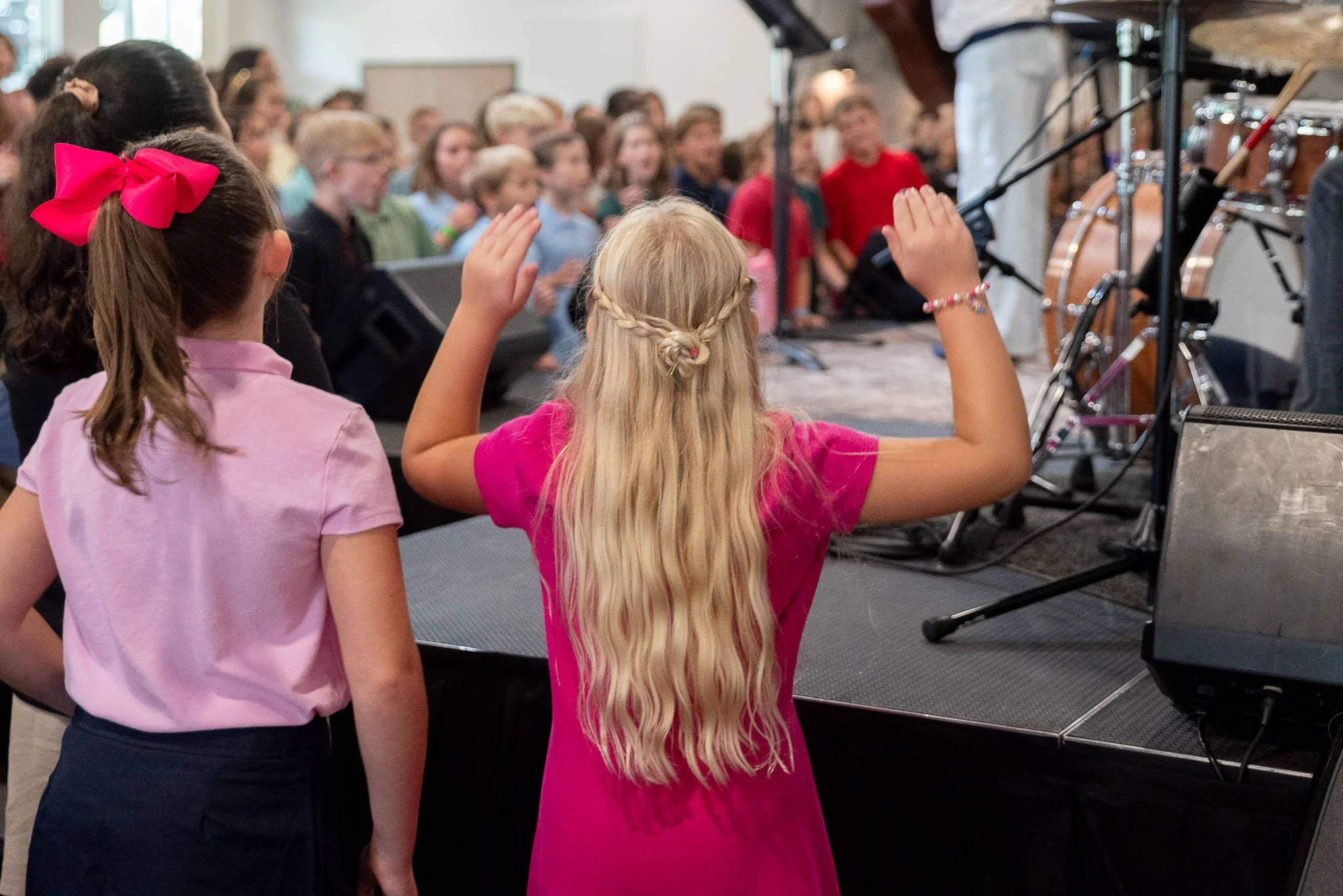
Each week, all K-12 students participate in chapel worship and bible teaching. This intentional time of focus on spiritual development is a guiding exercise for students to implement throughout other parts of their week.
Alongside learning the Bible, prayer is another essential component. It is not just the regurgitation of dead, religious words, but a connection to a living God. This is why prayer should be our first response when encountering problems, because without asking God for a heavenly perspective of how to solve the issue at hand, our solutions are going to be inadequate. By encouraging students to connect with the God who created the universe, it teaches them to step back, look at the bigger picture, and approach the issue with creativity. This gives them confidence to overcome the obstacles life will throw at them, in whatever form they may be, allowing them to be innovative thinkers as they move out of schooling and into the workforce.
Worship through song is a method to connect with God, and focus one’s mind and energies on him. Worship and prayer can lead to better emotional stability by providing an outlet as they share their struggles with the Lord. Spiritually healthy individuals will not be overcome by the distractions life lets in, but will be able to maintain focus on their times of education, knowing it is an essential step in the journey God has planned for their life. These spiritual activities of Bible reading, prayer and worship create focused, ingenuitive students who can critically think and who have direction. These are the types of students we want to develop, and spirituality in the classroom is how to get there.

Going Back to School? 5 Tips to Get Your Students Ready
Preparing for a new school year can feel overwhelming. Here are some tips to help ensure your students are prepared for a great year ahead!
Switching up schedules, gathering supplies, and preparing to face new educational challenges can be stressful for students and parents alike, especially when you are also saying goodbye to summer. Some years the transition is easier than others, but there are some things we can do to help our children start the school year off on a good note.
1. Get Back into Their School Routine Before School Begins
One way to prep kids for a return to school is by getting them on a schedule they will have during the academic year. If the kids wake up at 6:00 am and go to sleep at 9:00 pm during the school year, then get them back in this routine a week or two prior to classes starting. If they have after-school chores, have them do them at the time they will do them once school resumes. This minimizes the adjustments that will take place once school starts, allowing them to focus more on their new classes.
2. Build Up Their Mental Stamina Prior to Classes Starting
You don’t want your kid’s brain feeling fatigued after only the first week of school. To combat this, build up their mental endurance starting a few weeks before school begins. This doesn’t have to be anything intense, but by increasing the amount of time they spend reading, writing, memorizing, and engaging their minds can help them strengthen their attention spans and mental capacity, which can ease the transition from summer days to sitting in classes.
3. Get Organized
Make sure uniforms fit and are ready to go a week or two before. Get the necessary school supplies ready beforehand, with everything set to go for that first day back. Not only will seeing a backpack full of their necessary supplies help them mentally prepare, but it can also prevent the stress caused by last minute rushing.
4. Encourage a Positive Mindset by Focusing on the Benefits
Students can often have a bleak mindset when returning to school because they miss the freedom of summer, but by reinforcing the importance of the role education will play in their life, you can help them see its necessity. While there are some who look forward to it, many kids would give all they have if it meant prolonging the end of summer a couple of weeks. However, you can help set the stage for how they see going back to school. Even if it may not be exciting for them, reinforcing its importance to their future can help them see that it is an essential step for them to grow as a person, instilling in them the irreplaceable role education plays in their development.
5. Offer Moral Support
You know your children better than anyone else, and thus likely know what they are looking forward to as well as what they are dreading with the return to school. Consider what aspects of school they struggled with the previous year, and figure out a plan for how to overcome whatever issues they may have faced. Knowing they have your understanding and support will help to ease their overall stress levels, and help them have a more positive outlook as they approach the new academic year.