


STEM Comes to Life Through Integrated Learning
Jr High and High school STEM students explore how science, math, and technology span a variety of their courses to produce chemical reactions, flight paths, wave pools, and more!
Written by Ms. Rebekah Davis, M.S.
Spring is officially here and STEM teachers are taking it to the next level with experiments that get students up, active, outside and shooting things off into the sky!
Every good STEM teacher strives to help their students understand the application of their discipline -- to witness how scientific and mathematical principles don’t exist in a vacuum, but when integrated and applied to the real world, they unlock the potential to create! Teaching STEM in an engaging way is no easy thing. We are so proud of our Jr. High and High School teachers who work hard to make integrated learning happen.
Last week at the High School level, Ms. Castro (Math) and Ms. Hartnell (Physics) collaborated on a rocket ship project which had the students creating and launching bottle rockets across the field. In planning their rockets, each student had to consider drag, lift, thrust, center of gravity and center of pressure when designing a flying craft. They also learned how to calculate velocity and acceleration to build their quadratic equations.


LEFT: Ms. Hartnell guides students through the process of building rockets. Students had to consider drag, lift, thrust, center of gravity and center of pressure when designing a flying craft.
MIDDLE: High School Math teacher Ms. Castro looks for every opportunity to engage young bodies along with their minds. Coming back from Spring Break, she put chalk in the hands of Pre-Algebra students and turned them loose to review linear equations on the basketball courts. Students loved it!
RIGHT: After launching their rockets, students used the time and distance from their flight paths to build quadratic equations which mapped the trajectory in a parabola.
Meanwhile inside with the Jr. High students, Mr. Aaseby was making magic happen with a chemical experiment involving “elephant toothpaste”. Students analyzed the chemical reaction and pinpointed variables of the reaction, then changed those in order to produce a new hypothesis with a new result. 8th grader Blessing Davis says, “I learned how important it is to be really specific in predicting outcomes when the variables change.”
Not only were students applying the scientific method, the experiment also gave significance to the concept of exothermic reactions as the beakers were warm from the produced heat. One student who is reluctant when it comes to science shared, “Mr. Aaseby works so hard to make a difficult thing like science make total sense! I don’t really like science, but I’ve actually really enjoyed his class because he makes it easy for me to understand. He is most definitely a top example of what a teacher should look like.”
Bravo teachers, here at The Academy and all over our nation this year, who work so hard to provide an engaging learning experience for the students. We appreciate you!

Fall 2021 Enrollment & Prospective Family Events
Sign up today for your tour this spring! Applications for campus and homeschool programs are now released. We look forward to meeting you!

Spring 2021 is the time to learn more about the Academy for G.O.D. through a tour or open house. We hope you’ll plan your visit today!
At the peak of the 2020 global lockdowns imposed to counter the spread of COVID-19, 1.6 billion children were out of school.(1) Families immediately began experiencing the effects of having to care for their children, facilitate virtual schooling (if available), and maintain their own jobs. Despite being mandated to close our campus in March 2020, Academy students remained connected to their teachers and classmates, and 100% of students finished the spring 2020 semester in full. As we’ve moved into the beginning of the spring 2021 semester, our campus is open with over 230 students enrolled on campus or online, and our programs are thriving!
Our faculty and staff are committed to the best practices to promote the health and safety of each individual on our campus each day. With policies and prevention plans in place, we will continue to keep our campus open. However, the Academy also continues to offer programs for homeschool families in the Nashville area, the United States at large, and international students. If you have questions about which program would be the best fit for your family, please reach out to our admissions department. We also invite you to visit our campus this spring and learn more about who we are. All guests must RSVP to attend events this spring, so don’t miss your opportunity to sign up today!

The Complex Cortex of Camille Lively
8-10th grade students collaborate on a one-act musical to close out their performing arts course in the fall 2020 semester. The result was funny, thought-provoking, and impressive as they showcased their work before their classmates and teachers.

High school performing arts teacher, Mr. Ownby, with Esther Bargatze, playwright, and songwriters and musicians, Justice Garner and Kiah Roufs.
The 8th-10th grade performing arts students at the Academy for G.O.D. finished a semester of learning about performance related to theater and music. To end the course, students produced an original one-act musical titled “The Complex Cortex of Camille Lively.” The script, music, program artwork, and acting were all produced and performed by the students. I had the privilege of teaching and directing these talented students this semester as they accomplished this project and successfully performed their one-act musical on Friday, December 18th to an audience of their fellow students.
This class was such a joy as the giftedness and potential of each student was further unlocked as they responded to the challenges associated with producing this performance. It was a blessing to instruct the students and also be able to envision all of the ways that God will continue to use their skills for the world to better know and experience his goodness.
From Esther Bargatze, 8th grade student and lead playwright:

The play was written to give insight into what goes on in the complex growing minds of the young and lively, in a meaningful and comical way.
Life can be difficult no matter what stage you find yourself in, but being a teenager can be incredibly difficult as you try to navigate the world, figuring out how to be you while yet potentially so influenced by everyone and everything around you. “The Complex Cortex of Camille Lively” explores the tensions of being a young teenager through the main character of Camille Lively (Young and Lively) who gets bombarded by issues with her siblings, tensions with friends, and the various input she receives from her best friends that ultimately leads to her feeling misunderstood by everyone. Julian, Camille's best friend, offers the perspective of the young male teenager who also deals with the influx of voices from those close to him in his life that influence decisions he makes, good and bad. Ultimately, this is an exploration of the necessity for perspective-taking and communication. There's a lot to consider when navigating life, but these considerations are best made with a group of faithful friends surrounding you.
This musical production was written and produced by 8th-10th grade performing arts students at our school. The play is about a teenage girl, Camille, and all of her friends (Penny, Emily, Lucy, and Cassy) who have significant influence into the decisions she makes just by being themselves. Alongside Camille is her best friend Julian Barnaby, and his group of friends (Donald and Dan, Parry, Logan, Eddy, and Cory). Camile and Julian's friends are there to help communicate how much we can be influenced by our peers, but also to communicate thoughts and feelings that happen in teenage minds through each character.

As Camille continues to work through her feelings with the help of her parents, she learns the importance of considering others’ perspectives, and how to handle the strong emotions that can feel overwhelming.
Throughout the play, Camille faces challenges with her family, and when her emotions get ahold of her, it affects her behavior at school and her friendships. Camille is reminded that she is not alone and that she has friends, teachers, and her parents who love her and can offer her invaluable wisdom. When we were writing this play we wanted the theme to be about considering others’ perspectives, and not just thinking about our own. As teenagers especially it can be very easy to stop paying attention to the people around us because we're so caught up in our own feelings. We hope this production encouraged everyone to consider the interest of others a little more, to communicate, and to trust those around us who love us.

The Legacy Talent Show
in honor of their grandparents, our students took the stage to showcase their creativity and talents. The night was a blessing to all who viewed live and online!
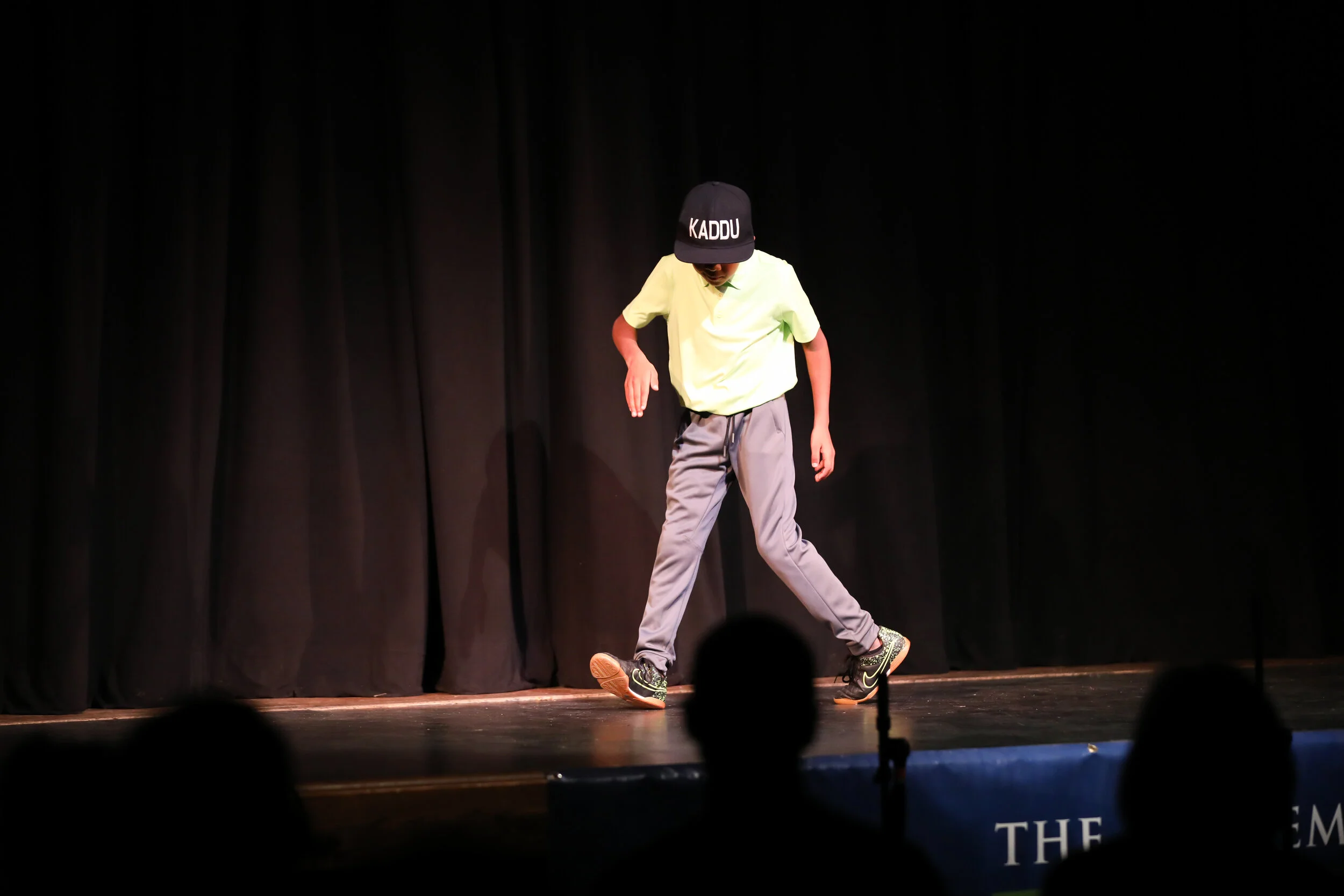
This past Saturday evening, 23 students from Kindergarten to 12th grade took the stage to dedicate the most sincere, heartfelt productions to some of The Academy’s dearest supporters: our students’ grandparents. From original songs and dances to martial arts and comedy acts, our students left the audience laughing, crying, and rejoicing over what they saw.
What did they see on the stage? One of our judges and a two-time Dove Music Award winner, Meredith Andrews, said it best: “This is more than a talent show. This is the heart of God on display!”

At the end of the night, each performer received a superlative award for their act. Sharing this moment of celebration was a highlight of the show!
The show’s theme was “Legacy”, which became a moving and emotion-filled thread throughout the night. Students expressed how their acts were inspired by their parents or grandparents. Others shared how their grandparents passed down a special talent to them that they in turn wanted to share with others. Two of our senior students even wrote a song for the Academy students coming up behind them, reminding them to practice what they learn in God’s Word because there is a world in need waiting for them. Each performer walked off the stage at the end of the night with a superlative in hand; an award given to them by the judges that distinguished their act above all the rest.
The Legacy Talent Show would not have been possible without the selfless service of our PTO and parent volunteers as well as our tech crew, made up of Academy high school students! In light of our month-long Legacy Campaign, our students have been learning what it means to receive and to leave a legacy. As the campaign highlights the Academy’s scholarship program, our students recognize they are receiving the gift of a Christ-centered education, and in turn are becoming equipped to bear the fruit of good works in the world. This was the inheritance on display during our Legacy Talent Show!
There’s still time to give towards the Academy’s Legacy Campaign! If you’d like to give the gift of a holistic, biblical education to students in the United States and around the world, we invite you to join us and thank you for your generosity!




When Challenges Become an Opportunity for Growth
Principal Castro reflects on the theory of growth mindset and the opportunity students have to develop through various challenges or trials they are presented with in adolescence.
Written by Mr. Alex Castro, Principal
“Great works are performed, not by strength, but by perseverance.” ~ Samuel Johnson, English Writer
Do you remember when the simplest tasks were the ones you could mindlessly complete? For instance, walking into a store and not feeling the pressure of having to wear a mask. Now, you have to go back to your car and get that mask if you forgot it on your way in. Our new normal, as a result of living during a pandemic, brings new considerations for what was once a simple task or routine. Those considerations are specifically tied to the safety of self and others. As adults, we’re able to separate these moments from past experiences and see the whole picture, yet we require our children to adhere to the same mindset in the midst of developmental stages that may contradict the very ‘reasonable’ reactions that we have as adults. I’d like to take a moment to look at where a typical middle school student is in their development.
Reflecting on my own experience as a middle school student, I vividly remember an awkward, gangling young man who would worry about what others thought of him. It lent itself to a lot of insecurities that were accompanied by negative thoughts about myself and my abilities. So essentially, I was a normal teenager. I had a hard time separating what I thought from the reality of what was happening. Everything was exasperated to new heights because, in the midst of the hormonal changes that my body was going through, my brain was also changing. I was entering the phase of development of formalized thinking, or the formal operational stage.

Whether in the classroom, recess or times of worship together, students are encouraged to consider the newness or change around them or challenges that face them as opportunities for growth and maturation as young people who love God.
The formal operational stage begins at approximately age twelve and lasts into adulthood. As adolescents enter this stage, they gain the ability to think in an abstract manner by manipulating ideas in their head, without any dependence on concrete manipulation (1). In short, adolescents are separating what is fact and what is fiction on their own. They are beginning to formalize what they know to be true based upon what is in front of them and not merely what they have been told. They are better able to think critically. They can think through problems that normally children would need the assistance of an adult. The issue comes when the adolescent is not properly guided. It is important to think of this stage as we interact with our moment and how a pandemic can stunt growth...if we let it.
In comes the theory of growth mindset to combat this stunting of growth. Growth mindset holds that an individual will put forth more effort, and thus lead to higher achievement, if they believe that their brain is more malleable (2), or that it can be shaped and grown. During the course of the impact that COVID-19 has presented, we find ourselves in a place as a nation looking forward to the unseen impact this historical moment will have on the future. This is where theories like growth mindset come into play.
At the Academy we incorporate the growth mindset into our K-12 curriculum. Students learn that in challenging moments, there is opportunity to grow. The book of James teaches us that we should even count such trials as joy (James 1:2-3). So then, the question is, “why?” Why encourage our students to embrace failure and struggle? The answer is simple. If we can teach our students to have strong emotion management skills and see their trial as an opportunity for growth, they are better prepared to face difficult situations and grow in endurance with clarity and understanding that they are exactly what scripture tells us in James...mature and complete, lacking in nothing (James 1:4). If I could go back and talk to that young man I was in Jr High, I’d tell him to embrace the struggle, lean on the Lord, and know that through that struggle you’re building your endurance and find the joy in your growth.
(1) McLeod, S. A. (2010, December 14). Formal operational stage. Simply Psychology. https://www.simplypsychology.org/formal-operational.html
(2) Decades of Scientific Research that Started a Growth Mindset Revolution. (n.d.). Retrieved from: https://www.mindsetworks.com/science/