






5 Ways To Help Students Be Their Best: How parents can help their kids succeed at school
Every parent wants their child to succeed at school, but this isn’t as easy as it may seem. After all, you aren’t in the classroom with your child, so how can you ensure they are going to succeed? Here are some tips to help you think through ways you can mold your child into being the best student they can be from outside the classroom.
1. Help Improve Their Self-Awareness.

At the Academy, parents are invited onto campus for formal events and teacher meetings throughout the school year. These visits are valuable to the parent’s involvement in the student’s school experience and relationship with their teacher.
If you don’t have a chance to be actively involved in the school’s PTO or other volunteer programs, make sure to talk with your child about the in’s and out’s of their school life. Who’s their favorite teacher? Why do they like the kids they hang out with and what role do they play in their circle of friends? What subjects do they enjoy, and which ones do they struggle with? This will help you help your child, by asking more focused questions that can help them better process their experiences. School can bring out a lot of insecurities in a child, and not every child is gifted with the intrapersonal skills to make sense of it all on their own. Asking personal questions and helping them talk through their thoughts and feelings can hopefully bring them some clarity concerning how they think about certain situations. Elementary aged students may be more prone to being open and vulnerable than middle school or high schoolers, but it’s never too late to start. Share with them ways that you’ve seen them change, and how they are growing. Self-awareness will help make them be their best as they will know how to better approach situations based on how they know themselves.
2. Give Them Opportunities to Explore
Part of students learning about themselves involves exploring new interests and figuring out what types of things they are good at or enjoy. Every child is different. What may be the most boring thing in the world to one child, may be seen as wildly interesting to another. Providing strong emotional support will help students be more willing to try new things, as it builds confidence knowing that they will still be loved and supported even if they fail. It will give them the encouragement they need to further explore certain interests which can help build self-confidence as they begin learning more about themselves. This shapes their mindset and can help them develop as a student.
3. Develop their Strengths
When you see a child has a knack for a skill, provide opportunities for them to develop it. If they are athletic, try to get them on a sports team, or if they are musically inclined, enroll them in a music camp. Encourage them to find ways in which they can enhance the natural skills they have. As they develop these talents, they are also developing their minds as they learn the ins and outs of a skill. This not only boosts their confidence, but will help shape the way they view themselves. They will be more okay with their weaknesses knowing that they have strengths.

Parent-teacher meetings are welcome and encouraged at the Academy. Our teachers invest into a partnership with the students and parents in order for the student to have a successful learning experience.
4. Overcome their Weaknesses
Everyone has weaknesses and the sooner they are addressed, the sooner they can be caught up to speed with others. While no child is going to want a tutor, if they are falling behind in a certain subject then it may be an appropriate way to help them succeed. However, before hiring a professional tutor, you may want to try other options first. While children may react differently when their parents try to teach them, if you can find the time you may be able to tutor them yourself. If not, see if there are friends who are skilled in that subject who could tutor them. Other options may be hosting some of their classmates for a group study session. By opening your home to allow students to work on group projects or study for upcoming tests, you are encouraging both healthy academic and social practices. Getting students to be comfortable having weaknesses and being willing to face them head on is beneficial both in and out of the classroom.
5. Challenge Them
Another way to help your student become the best they can be is by making sure they are challenged. This doesn’t just have to be in a purely academic sense, but by getting them out of their comfort zone and participating in activities they would rather avoid, it can stretch their familiarity, expanding their willingness to try things they would otherwise shy away from. When this attitude is applied to their academics, it helps students approach new topics with greater optimism even if it is in a subject they are weak in or unfamiliar with.

Biblical Education Put into Practice: Monthly Service Project Highlights
At least once a month, Jr High and High school students have the great privilege of serving those in need in our community and the greater Nashville area. It’s a practical way our students are learning to put the biblical education they receive in the classroom into practice.
At least once a month, Jr High and High school students have the great privilege of serving those in need in our community and the greater Nashville area. It’s a practical way our students are learning to put the biblical education they receive in the classroom into practice.
This month, students served both on our school campus and neighboring communities. It is such a joy to see our students work together, strategize, and display teamwork to meet needs. Here are a few highlights:
Life Care Center- A group of students went to the Life Care Center, an elderly home in Madison, TN. They sang three worship songs and played bingo with the residents. One of our students even got to call out the bingo numbers for the game! The presence of youth brighten the day for the residents, and it’s a blessing to see our students shine in this way.
Hopewell Neighbors- A group of students also planted flowers at an elderly woman's home across the street from our school and raked leaves in one of our neighbor's yard!
School Playground & Elementary Students - Students weeded our elementary playground and the memorial garden to beautify our school campus.
Parents Day Out and Pre-K - Students weeded around the Parents Day Out Program building to beautify our entire campus.
Ugandan Students - Students wrote letters to our home education students in Uganda and encouraged them in their studies with midterms taking place. They were so precious as they have felt more and more connected to these students over the years and looked forward to connecting with them in this way.
The Elderly at McKendree Village & Chippington Towers - Students used their time yesterday to plan for a Christmas party at McKendree Village and Chippington Towers. This is a highlight for the residents each year!


“In the same way, let your light shine before others, so that they may see your good works and give glory to your Father who is in heaven.” - Matthew 5:16

A Prayer to Be Enduring Problem Solvers
Deputy Headmaster, Ms. Corey Foster, reflects on a student’s prayer to open her creative arts class and how such a request from the Lord informed their class on critical thinking and SEL skills.
On Monday morning this week, my 7th grade Mixed Media Art class began with a student led prayer that has impacted me all week. The words of this student’s prayer included, “Lord, give us the patience to be effective problem solvers. Help us to not get down on ourselves when we have to try something again, because we are students and we are still learning.”
Sit with that. Read it again. Think about a 13-year-old student asking for this type of help from the Lord for herself and her classmates.
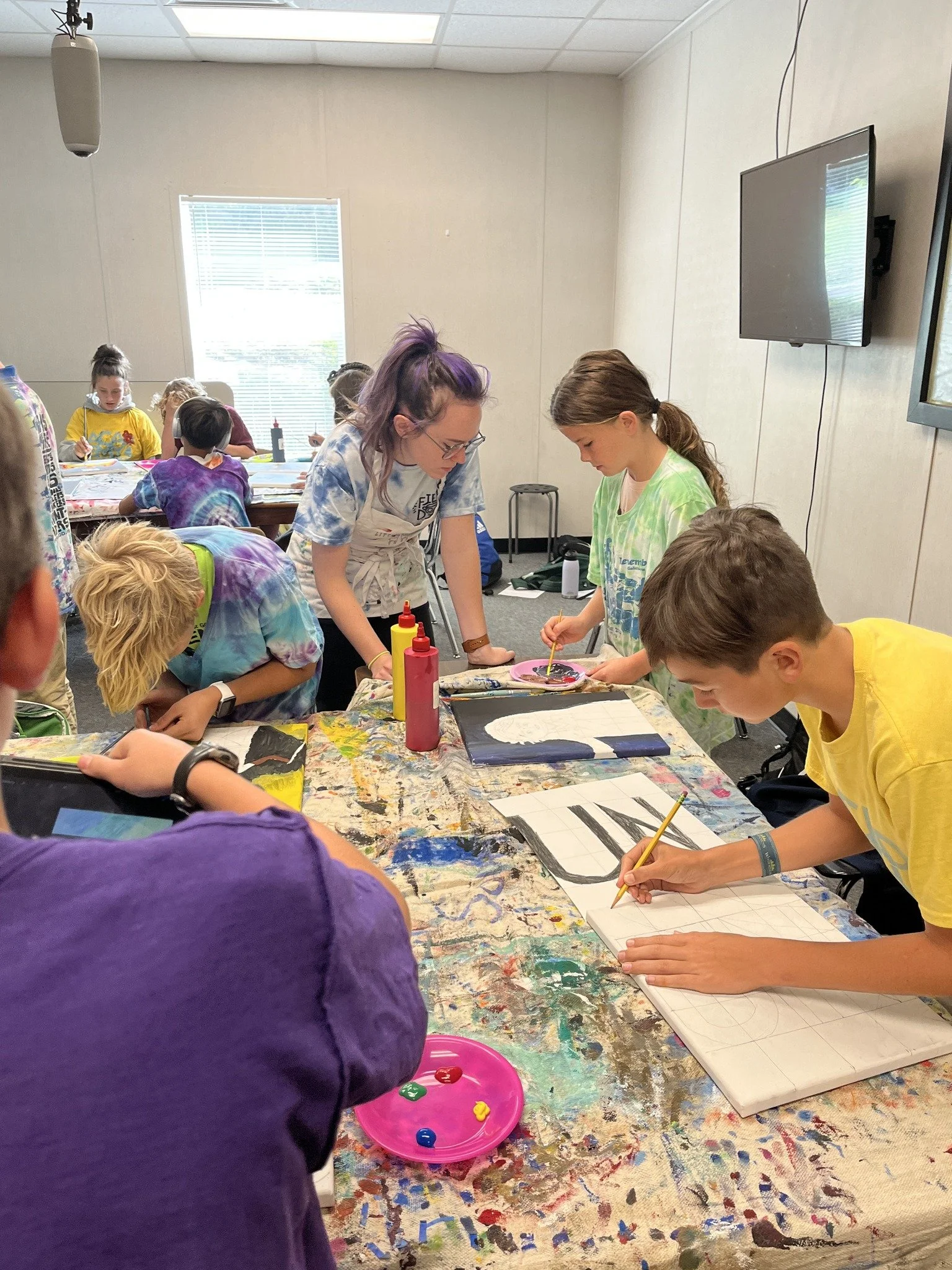
Natania, a senior at the Academy, joins us for a portion of each art class for her Teaching Practicum course. This course is designed to give seniors practical skills related to teaching concepts to younger students. She is learning to communicate with students in a way that effectively helps them think through visual art processes and encourages them towards good work. She is pictured above helping a student talk through the process of making a brown paint color for the skin tone of a girl from India. It's been a blessing to have her join us.
These words are profound for a few reasons. First, teens today are faced with all kinds of social media that promotes fast paced pressure for them to have an appearance that they have things figured out. This prayer directly opposes what the culture they are living in demands and instead, sticks closely to God’s hopes for them. Second, our values here at the Academy resonated in this student’s prayer. She not only acknowledged herself and her classmates as students, but took the humble position that they are in need of continued growth because they are learning. Finally, she acknowledged that this would take patience and isn’t something that can be faked (James 1:22).
To make God proud (Law #3 - Exodus 20:7), these students are implementing what it looks like to uphold God’s reputation. They are learning to recognize that their efforts to become effective problem solvers can only come from God’s presence in their life, their knowledge of the word of God, and their ability to walk it out in obedience. Their hard work and faithfulness to the tasks and projects given to them is a sign of their obedience.
After the class collectively said “Amen,” I was able to encourage the students that learning to be effective problem solvers according to God’s word is a lifelong practice. The adults around them engage in problem solving every day and we are prayerful in our considerations along these lines as well. I pray that they can continue to hold this type of reliance on the Lord as they are becoming the people that God needs in the world.
After this wonderful moment, students dove into their art workshop developing class murals. Their first quarter project is to collectively create a mural that expresses a value that they chose from God’s word that has been highlighted during their time at the Academy. One group chose the theme of “Unity” with an emphasis on people from around the world working together. The other group chose the theme “Rise Up” and are working through the resurrection motif that comes with our school's mascot, the Phoenix.
Students are engaging in higher order thinking skills related to creating artwork that communicates a theme or concept based on their knowledge and ability to apply and analyze it. This project has required students to problem solve with measurement (more math than they would have imagined fitting into an art class), color mixing, and painting. Students are also engaging their SEL skills of teamwork and communication to effectively problem solve their project as a team. I’m seeing wonderful fruit during this first quarter of Jr. High!
Exploring the Visual, Auditory and Physical Styles of Learning: The Benefits of Various Teaching Styles
Simply put, learning styles are the different ways in which a person intakes information. While there are multiple ways to analyze this, one of the easiest ways to break this down is through our senses.
Simply put, learning styles are the different ways in which a person intakes information. While there are multiple ways to analyze this, one of the easiest ways to break this down is through our senses. Students learn through seeing, hearing, and handling the subject matters taught to them. Some children are more prone to retaining information when presented in a certain way, and thus one student may learn more quickly through hearing a teacher’s lesson while another may better grasp the concept if that same information is formulated into a graph. With that said, here is a quick breakdown of some of the learning styles and how they can be used.
Visual: Here are some ways in to use visualization to your advantage: Use multiple colored pens when taking notes to color-coordinate certain ideas, create graphs, charts, webs, and illustrations to depict the information you were taught, make a mind-map to see how various ideas connect to each other, or put facts on images and make a review collage.
Auditorial: Some people prefer learning through hearing the information, so here are some study ideas: Listen to energizing but not distracting music while studying, memorize facts by putting them to the tune of a popular song, download lectures and re-listen to them in the car on the way to soccer practice, read through your notes out loud, or take turns with a study partner re-teaching each other the information by putting it in your own words.

During a lesson exploring the digestive system, students participate in hands-on experiments to guide their understanding of the course material.
Physical: Get moving! This style of learning requires you to use your body: Act out what you are trying to learn as if rehearsing for a play, read your notes while walking or chewing gum to keep your subconscious busy with movement to help your mind focus on what you need to memorize, put choreography or dance moves to the information you are trying to memorize, or place index cards of facts around the room and connect them with string. Anything that gets your body moving in sync with your brain as you digest the information can be beneficial for a kinesthetic style of learning.
For rather obvious reasons, the smelling and tasting methods are rarely used. While delicious, writing your notes in icing on a cake and then eating it is neither practical nor efficient, even if you do technically digest the information.
What’s a way to wrap all of this into one useful study tip: draw your notes. Edutopia explains how drawing while notetaking can increase retention rates by utilizing multiple learning styles at once. The student is intaking the information audibly by listening to the lecture; by depicting the information in charts, symbols, or pictures, they are constructing visuals; and by using their hands to draw, they are keeping their body physically active.
While certain learning styles may come easier to some than others, we should avoid pigeonholing anyone to a specific style. If not understood correctly, a student may lay blame on the way a topic was conveyed rather than trying to take responsibility for trying extra hard to understand the concept. Rather than looking to strengthen a weakness, they may turn it into a handicap. This may be why the developer of the multiple intelligence theory, Howard Gardner believes it best to leave behind the term “learning styles,” even though he does highly encourage educators to “pluralize” their teaching methods.
SOURCES:
Northern Illinois University Center for Innovative Teaching and Learning. (2020). Howard Gardner’s theory of multiple intelligences. In Instructional guide for university faculty and teaching assistants. Retrieved from https://www.niu.edu/citl/resources/guides/instructional-guide
“Howard Gardner's Theory of Multiple Intelligences.” Northern Illinois University. (visited 24 March 2022)
Cherry, Kendra. “Gardner's Theory of Multiple Intelligences.” VeryWellMind.com. July 28, 2021 (visite 24 March 2022)
https://www.verywellmind.com/gardners-theory-of-multiple-intelligences-2795161
Terada, Youki. “The Science of Drawing and Memory.” Edutopia. 14 March 2019. (visited 4 April 2022)

New Year, New Logo: Here’s what it represents.
We gave our school logo a fresh look for the start of our 10th year! Here’s the meaning behind the design.
Our logo just got a wonderful makeover for our 10th year, and we couldn’t be more excited about it. This emblem shows off some core values of our school. The new logo is a silhouette of a phoenix head in front of five blue flames, all above an open book. It looks amazing, but what does it mean? Well, let us explain…

The Flames:
The five blue flames are representative of the five goals set in our mission statement, the first of which is providing holistic education. There are also five categories which make up holistic education: academic, emotional, social, moral, and spiritual. The next is implementing this holistic education to teach children how to be responsible, kind, and ethical neighbors. The last three also deal with how we strive to shape students into being ones who are competent persons, who are globally conscious, and who are historically relevant.
The Phoenix:

The Phoenix serves as the school’s mascot, but was chosen so due to what phoenix’s are known best for: resurrection. We believe resurrection is a core element of our faith in God. The resurrection of Jesus reveals that God is the final judge and that life in him can triumph even over death. It is the epitome of hope, and is essential to our walk of faith. Our desire is to instill this undying flame of perseverance in the students, teaching them to stand firm in the fact that their hope in God does not disappoint (Rom. 5).
The Book:
The open book in front of the Phoenix is from where all our values derive: the Bible. It is not a closed book left on a shelf only to serve as a reminder of ancient traditions, but it is one we constantly open to study, so we know how to maneuver an ever changing world. Through meditation and study, we derive principles and lessons that can be applied in a relevant way to a watching world, allowing us to be a light in a world too often characterized by darkness.
A special THANK YOU to Genovations Media for the fresh design. Your team is always a pleasure to work with!