Remote Learning: Here's What Students Are Saying

Last week we celebrated the end of the school year with our Remote Learners in Uganda. We are so proud of these 8 students who navigated challenges related to WiFi, technology and time zones to successfully complete this school year! Every time they Zoomed into a class they brought joy, thoughtful contributions and a fresh perspective to their classmates. Read about their experience!

Last week we celebrated the end of the school year with our Remote Learners in Uganda. We are so proud of these 8 students who navigated challenges related to WiFi, technology and time zones to successfully complete this school year! Every time they Zoomed into a class they brought joy, thoughtful contributions and a fresh perspective to their classmates. 

Virtual meetings, like the one in this photo, happen on a regular basis between our administration and education facilitators in our international regions to ensure support is extended and prayers are shared for the work being done in the remote learning program.

Academy administration joined all the students on a Zoom call along with their Education Facilitators in Uganda, Lawrence and Josephine Ssemakula. Each student shared a highlight from the year, and then received a superlative related to a characteristic their teachers had noted in them this year. Students were appreciated for qualities like Joy, Initiative, Faithfulness, and Diligence. 

After the call Lawrence Ssemakula noted how special this celebratory moment was. “This is so encouraging because no school here [in Uganda] would do such a thing that is biblically rooted and also teachers caring so much to know students to this degree. It helps them a lot to feel valued and loved.They were very happy and I asked the parents that we should take them out to have a special moment with them.”

8th grader Victor spoke for all the students when he said, "I thank all the teachers that taught us this semester because when we had some difficulties in our assignments they were able to answer our questions and answer those questions through our live classes although our internet was not stable. But they tried to help us."

Thank you LORD for a blessed school year! We so appreciate the hard work of Academy teachers in integrating remote learners, and for the support of our financial donors that helped ensure these precious students could receive a rich year of learning! 

Please enjoy the student highlights below. 

Barnabas (11th grade) - “I enjoyed the classes, they were very good, and the due dates were easy to meet. Another thing is that all the lessons were rooted in the word of God. It was a good thing to put in our minds when doing those classes. It helps motivate people. 
I did a project about solar (energy) and it took me some time researching and finding a store that had the exact supplies and making calculations and adjustments on those specific materials. My interest in such projects increased and I guess I will be making more of these in the mere future. I think it may be the first step in my future job career.”

Rebecca (9th grade) - “For me this semester was like an adventure exploring many things I didn’t know. I loved Historical Biographies class, especially learning how Martin Luther King had a way of using nonviolence to bring peace. I know that I was not actually violent like hitting people but sometimes in my words I was violent to some people even to my siblings. But I think this class has helped me a lot and is going to change me in some ways.”

Genesis (9th grade) - “My most favorite course was the Biology class because we had to do all those different projects which made us really creative and helped us to not just write notes in our books but also have those notes in our projects. So that helped me be more creative even in my life.”

Gideon (9th grade)“The class I prioritized a lot was Wisdom Literature. It helped me know how to read more and how to understand the Bible.”

Favour (8th grade) - “I highlighted the Prophets (Bible class) and Historical Biographies because they had the same point. Both of them tell us to be peacemakers. If Israel had tried to be peacemakers like Nelson Mandela many people wouldn’t die. 

Also I liked the course that helped us take photos and create them properly. And Language Arts, I learned to read things and understand them and it helped me to understand things that are taught in the scripture.” 

Victor (8th grade) - "My highlights were mostly from Bible and Language Arts classes. In Bible class we learned about Eli’s sons and how they did not walk in God’s word. For me I thought that God killed Eli’s sons, but our Bible teacher taught us that God did not kill them; they were killed by the world. They went into battle and didn’t go with God so that’s why they were killed. 

And in Language Arts I highlighted the book The Boy in the Striped Pajamas. Some of the lessons I learned was forgiveness because in our daily lives we don’t usually forgive people. But the book helped me to forgive people"

Genevieve (6th grade) - "My favorite course was STEM. I learned math and we learned science. We learned about the environment and they showed us a picture of a lake which has trash around it, and they showed us a lake which is clean, and they taught us that after we use papers and packages we should put them in the trash."

Read More

Academy for G.O.D. Ranks in 5 ‘Best of Nashville’ Categories

We’re proud to be featured among the top 3 in 5 of the Best of Nashville categories this year!

Since 1988, The Nashville Scene, a free "alternative newsweekly," gathers votes for the "Best of Nashville" contest. Prized certificates can be seen in frames in restaurant lobbies, food trucks, dentist offices, and beauty salons throughout the city. Nashville citizens vote for their favorite businesses in over 250 categories with detailed contest rules and zipped-lip results until the "Best of Nashville Day" in October each year. 

In the Nashville Scene’s Best of Nashville Contest 2021, we are proud to announce that The Academy for G.O.D. placed in five categories: 

  1. Best Elementary School - 3rd Place

  2. Best Middle School - 2nd Place

  3. Best High School - 3rd Place

  4. Best Private School - 2nd Place

  5. Best Teacher: Robert Muñoz - 2nd Place

Established in 2013 with 22 students, The Academy for G.O.D. offers innovative education for students K-12. Birthed out of the ministry of Global Outreach Developments International, The Academy for G.O.D.'s mission is to “holistically educate children to become responsible, kind, ethical neighbors; competent persons, globally conscious and historically relevant." Today, The Academy is home to 250 students across its campus program in Old Hickory, its hybrid program for homeschool students, and its online program reaching remote learners across the globe. 

Courses are biblically-based with an emphasis on Social-Emotional Learning. Teachers are challenged to recognize and cultivate the Multiple Intelligences each child may be most gifted in (linguistic, mathematic, kinesthetic, musical, interpersonal, interpersonal, and spatial). The Academy has a growing athletic department with a committed fan base (Go Phoenix!) and diverse after-school clubs (chess, yoga, geocaching, etc.). They provide annual STEM fairs and contests, Grandparents Day, Talent Shows, and Student Performance showcases. It is also a nationally recognized farm-to-school program incorporating fresh produce and meats from local sources, featuring produce from G.O.D. International’s Hopewell Farms. Most importantly, the Academy is surrounded by supportive parents who regularly pray for Academy students, teachers, and staff. 

The COVID-19 pandemic accelerated an existing goal to make Academy education available to more students via an online platform. Today, students from Uganda and the Philippines attend live courses via Zoom, bringing a global experience into the classroom. As for the kind and ethical portion, students have Bible courses every day and regularly participate in service opportunities benefitting their Nashville neighbors. (You may find Academy students sharing music with a retirement community, an Academy high schooler teaching a painting class to individuals with special needs, or junior high or high school students serious about learning Spanish for their cross-cultural mission experiences.)

The Academy for G.O.D. is a Category IV non-public school registered with the state of Tennessee and a member of the Association for Christian Schools International (ASCI). Academy teachers and staff have been featured speakers and facilitators for ASCI conferences in South East Asia. 

As for our honored teacher, the late Robert Muñoz, he was simply the best. Robert played a major role in getting the Academy off the ground in 2013. Over the years, Rob, who had his Master in Public Health, taught Science and Biology to all age groups. He also regularly spoke at weekly chapels, led worship, and gave 200+ kids a positive start to their day through his famous morning announcements. Rob’s latest and most honored position was the Elementary Vice-Principal, which he held from 2018 to 2021. Rob passed away in July of 2021, leaving behind his wife and five amazing kids who all attend The Academy for G.O.D. Rob, who loved to celebrate and be celebrated, would have felt so honored to have received this award. We believe he's cheering as loud as he always did for his Academy family today. 

Thank you, our beloved Academy family and Nashville voters, for cheering on the Academy for GOD! We are happy to continue raising the next generation to be kind, ethical neighbors who consider all people God's family worthy of love and respect. Join in the cheer Mr. Muñoz so often led us in: Phoenix - Rise Up!  

Read More

Life Changing Generosity - Thank You, Donors!

Be encouraged by an update on our Legacy Scholarship Program as donors contributed to over 100 Academy students receiving the opportunity to continue their education last year despite the challenges of a global pandemic.

The Academy for G.O.D. invites you to participate in the The Legacy Scholarship Program (LSP). The LSP was created to provide national and international students with an affordable education model - one that many experts have described as “the future of education.” The LSP acknowledges student athletes, academic exemplars, as well as families with financial hardship.

The Academy for G.O.D. invites you to participate in the The Legacy Scholarship Program (LSP). The LSP was created to provide national and international students with an affordable education model - one that many experts have described as “the future of education.” The LSP acknowledges student athletes, academic exemplars, as well as families with financial hardship.

The Arts Scholarship is one avenue students can receive financial support, by demonstrating noteworthy skill in the performing arts. Students are able to showcase their skills through opportunities like weely chapels, school assemblies and events.

The Arts Scholarship is one avenue students can receive financial support, by demonstrating noteworthy skill in the performing arts. Students are able to showcase their skills through opportunities like weely chapels, school assemblies and events.

Last year The Academy for G.O.D. gave over $170K in needs-based scholarships to students around the world. As the pandemic caused schools to close, we were able to offer dozens of students the option of online education. In the midst of a struggling economy, we also also provided scholarships to 110 students from families in need to remain in school here on our Nashville campus. These scholarships were offered thanks to the generosity of many like you, who donated to support K-12 education in our annual Giving Campaign. We THANK you. Families were impacted and blessed in truly life changing ways.

Lawrence Ssemakula , a father and educator in Uganda took the lead in organizing the dozen students in Uganda who enrolled in the Academy Remote Learning Program when local schools closed down due to Covid-19.  His children are still taking a full load of classes online with us, as Ugandan schools have yet to re-open.

“For us it was an answered prayer to our situation in Uganda where schools have been closed for nearly two years. God heard our cry, he intervened when we had no idea of what to do next and responded to our prayer. Our children are getting the best education we'd never thought of.

Secondly, the students have an opportunity to take classes which they can manage unlike in their former schools which had a broad curriculum with many subjects. The content is very adequate and mostly practical which has made them enjoy the learning, it meets their learning abilities.”

As Ssemakula noted, it has been nearly 2 years since the youth of Uganda have been out of school, and now are facing a slew of challenges related to learning gaps and a sharp rise in teenage pregnancy (1). Thankfully, his children and others who received scholarships to the Academy have had continued access to engaging and biblically based education. 

Here in Nashville many families also faced financial hardships, and were able to apply for scholarships. Because of the generosity of our donors, students were able to attend classes, participate in our Phoenix sports program, take part in talent shows and STEM Fairs, and receive 2 nutritious meals a day on campus. What a gift! 

Thank you for your consideration and continued support. We are committed to providing the best education possible to students that would otherwise not have the opportunity. Our prayer is that the Lord provides the means, both spiritually and monetarily, to continue His great work through donors like you!


Left: Educator Lawrence Ssemakula says “We appreciate the (Academy) teachers’ way of teaching. It's not easy to get students engaged in learning virtually. Our children enjoy learning due to the teachers' carefulness demonstrated through meeting the students' individual needs and even following up on individual students to ensure they are enjoying their studies.”

Right: “My family chose to use the Academy online program during a season of life that had many unexpected challenges.” says Deb Nava, of her 1st and 3rd grade students. “The flexibility of the program allowed us to quickly work through some material or spend extra time on the classes my kids loved. Our weekly check-ins with a teacher were helpful to keep them on track or ask questions about certain assignments. I felt really good about the progress they made while at home, and I knew they would confidently be on par with peers in the classroom. It’s an excellent program and I’m so thankful we had a positive experience during a hard season.”

(1) COVID-19: Education replaced by shuttered schools, violence, teenage pregnancy https://news.un.org/en/story/2021/07/1096502

Read More

The First Two Weeks of School: A Valuable Transition

The 2021-2022 school year has begun, and as with every year, our students come in to a two-week alternative schedule to prepare them for the year ahead. Here’s why:

Have you ever had that Sunday morning church experience where you’re rushing to get the kids out the door? Everybody fed, check! Everybody dressed, check! Kids to their Sunday school rooms. Quick restroom stop. When you finally sit down in the pew, you can breathe a sigh of relief. Even though you are a few minutes late, you’re here and it’s time to settle in. As the music begins you take a deep breath and calm your mind by moving through the mental checklist: Yes, you turned the stove off at home. Yes, you packed the diaper bag, yes you locked your car in the parking lot… and you begin to mentally transition to focusing on this time with the Lord ahead of you.

This reality of transition is one that we acknowledge and accommodate for at the start of every school year. It’s our “two-week alternative schedule” where we acclimate, assess and settle the students in for the new year of learning.

Maybe you’ve heard your student say something like, “Well, we haven’t started our real schedule yet…” They’re not wrong! But although they have not begun their academic schedules, they have most definitely begun their school year. 

High school students begin the school year meeting new classmates with opportunities to reflect on their summer where many of them participated in national and international mission opportunities.

High school students begin the school year meeting new classmates with opportunities to reflect on their summer where many of them participated in national and international mission opportunities.

Acclimation, assessment and “settling in” is the simple way to understand what happens during our first 2 weeks of the school year. 

During their first few days back on campus, students are acclimated back into the school setting by reconnecting with peers, getting to know their teachers, and reviewing school routines and behavior expectations. At the elementary level this looks like remembering how to line up, how to move through meal service times, when they can use the restrooms, and what activities are appropriate for indoor recess. Before we begin administering any demerits or incentives, students simply get these few days to adjust into being back at school. 

Assessments come next, which do include academic assessments but also social and emotional. Through review exercises and games, teachers gauge how much their students remember, while also evaluating the demographics and personality of their new class. Is it a 2:1 ratio of girls to boys? Might need to adjust the sport through which Jr. High students will learn Game Strategies. Is it a class full of kinesthetic learners? Need to buy some more manipulatives for math class. Does this group of developing readers need to be on their feet for Language Arts courses? How about a readers’ theatre? Assessments provide teachers the data they need to teach students, not just classes. 

Finally, during the last few days of our alternative schedule, students settle in for the upcoming year. For 7th graders this looks like the reminder that, although they will now be receiving a number grade on every assignment, they are not their grade. They are more than a number. And school is the safest place to be wrong, to make mistakes and to grow. For our Juniors and Seniors, this looks like several blocks of research, reflection and discussion with teachers to decide on senior projects, internship placements and directed studies. 

So next time your student mentions that they haven’t started ‘regular school yet’, you’ll know what they mean! And you can follow up with questions like, “Tell me about your new teacher!” “What’s something you’re excited for/nervous about in this upcoming year?” Or even, “Remember to get to bed early tonight because your body is adjusting to the school year.” Here’s to being ready for a wonderful year of learning!


Elementary students use team-building exercises and games to develop their class dynamic and healthy interactions with one another.

Elementary students use team-building exercises and games to develop their class dynamic and healthy interactions with one another.

Read More
Jr High Blog, Principal Blog Alex Castro, Principal Jr High Blog, Principal Blog Alex Castro, Principal

When Challenges Become an Opportunity for Growth

Principal Castro reflects on the theory of growth mindset and the opportunity students have to develop through various challenges or trials they are presented with in adolescence.

Written by Mr. Alex Castro, Principal

“Great works are performed, not by strength, but by perseverance.” ~ Samuel Johnson, English Writer

Do you remember when the simplest tasks were the ones you could mindlessly complete?  For instance, walking into a store and not feeling the pressure of having to wear a mask. Now, you have to go back to your car and get that mask if you forgot it on your way in. Our new normal, as a result of living during a pandemic, brings new considerations for what was once a simple task or routine. Those considerations are specifically tied to the safety of self and others. As adults, we’re able to separate these moments from past experiences and see the whole picture, yet we require our children to adhere to the same mindset in the midst of developmental stages that may contradict the very ‘reasonable’ reactions that we have as adults. I’d like to take a moment to look at where a typical middle school student is in their development. 

Reflecting on my own experience as a middle school student, I vividly remember an awkward, gangling young man who would worry about what others thought of him. It lent itself to a lot of insecurities that were accompanied by negative thoughts about myself and my abilities. So essentially, I was a normal teenager. I had a hard time separating what I thought from the reality of what was happening. Everything was exasperated to new heights because, in the midst of the hormonal changes that my body was going through, my brain was also changing. I was entering the phase of development of formalized thinking, or the formal operational stage.

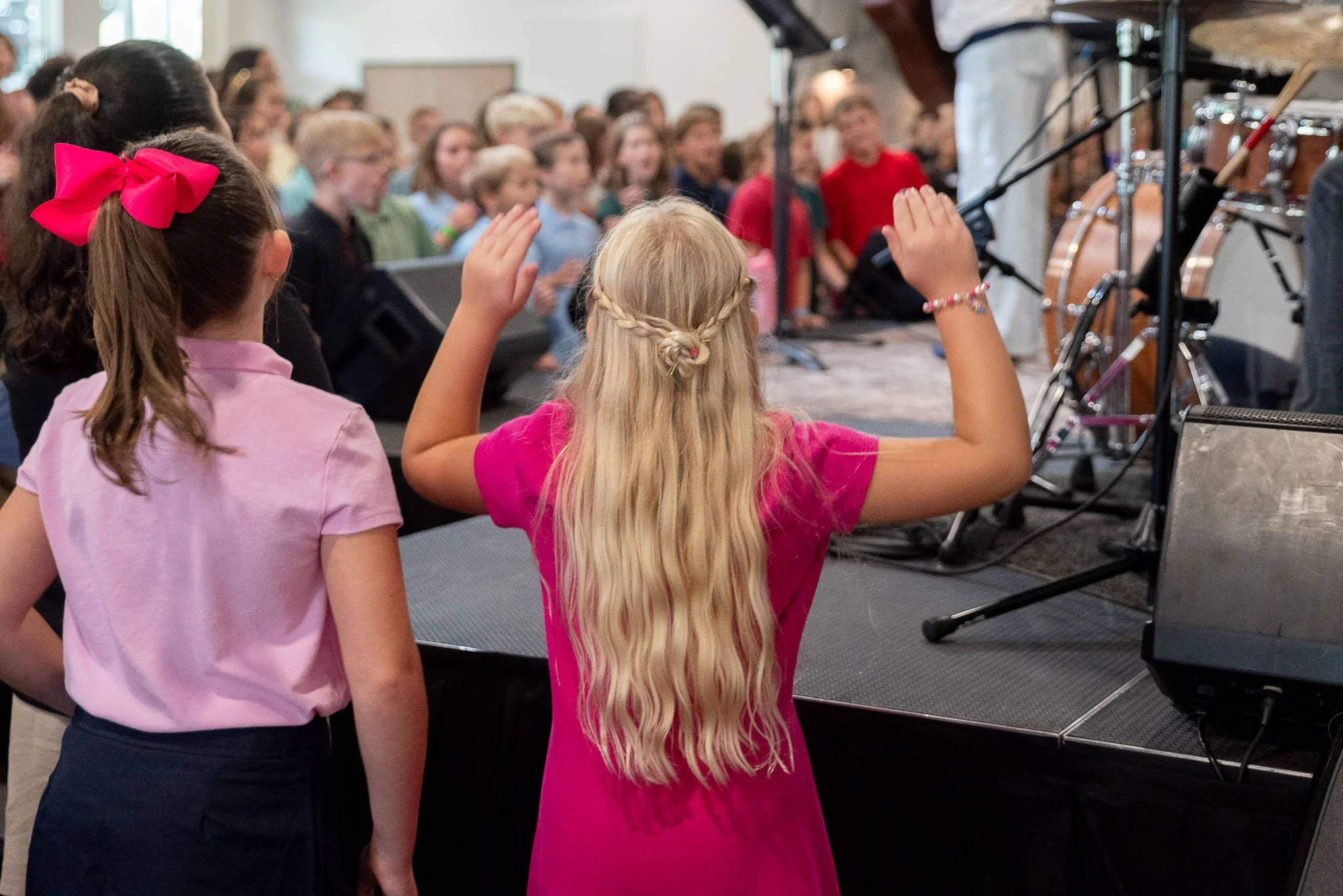
Whether in the classroom, recess or times of worship together, students are encouraged to consider the newness or change around them or challenges that face them as opportunities for growth and maturation as young people who love God.

Whether in the classroom, recess or times of worship together, students are encouraged to consider the newness or change around them or challenges that face them as opportunities for growth and maturation as young people who love God.

The formal operational stage begins at approximately age twelve and lasts into adulthood. As adolescents enter this stage, they gain the ability to think in an abstract manner by manipulating ideas in their head, without any dependence on concrete manipulation (1). In short, adolescents are separating what is fact and what is fiction on their own. They are beginning to formalize what they know to be true based upon what is in front of them and not merely what they have been told. They are better able to think critically. They can think through problems that normally children would need the assistance of an adult. The issue comes when the adolescent is not properly guided. It is important to think of this stage as we interact with our moment and how a pandemic can stunt growth...if we let it.

In comes the theory of growth mindset to combat this stunting of growth. Growth mindset holds that an individual will put forth more effort, and thus lead to higher achievement, if they believe that their brain is more malleable (2), or that it can be shaped and grown. During the course of the impact that COVID-19 has presented, we find ourselves in a place as a nation looking forward to the unseen impact this historical moment will have on the future. This is where theories like growth mindset come into play. 

At the Academy we incorporate the growth mindset into our K-12 curriculum. Students learn that in challenging moments, there is opportunity to grow. The book of James teaches us that we should even count such trials as joy (James 1:2-3). So then, the question is, “why?” Why encourage our students to embrace failure and struggle? The answer is simple. If we can teach our students to have strong emotion management skills and see their trial as an opportunity for growth, they are better prepared to face difficult situations and grow in endurance with clarity and understanding that they are exactly what scripture tells us in James...mature and complete, lacking in nothing (James 1:4). If I could go back and talk to that young man I was in Jr High, I’d tell him to embrace the struggle, lean on the Lord, and know that through that struggle you’re building your endurance and find the joy in your growth. 


 (1) McLeod, S. A. (2010, December 14). Formal operational stage. Simply Psychology. https://www.simplypsychology.org/formal-operational.html 

(2)  Decades of Scientific Research that Started a Growth Mindset Revolution. (n.d.). Retrieved from: https://www.mindsetworks.com/science/

Read More