




5 Ways To Help Students Be Their Best: How parents can help their kids succeed at school
Every parent wants their child to succeed at school, but this isn’t as easy as it may seem. After all, you aren’t in the classroom with your child, so how can you ensure they are going to succeed? Here are some tips to help you think through ways you can mold your child into being the best student they can be from outside the classroom.
1. Help Improve Their Self-Awareness.

At the Academy, parents are invited onto campus for formal events and teacher meetings throughout the school year. These visits are valuable to the parent’s involvement in the student’s school experience and relationship with their teacher.
If you don’t have a chance to be actively involved in the school’s PTO or other volunteer programs, make sure to talk with your child about the in’s and out’s of their school life. Who’s their favorite teacher? Why do they like the kids they hang out with and what role do they play in their circle of friends? What subjects do they enjoy, and which ones do they struggle with? This will help you help your child, by asking more focused questions that can help them better process their experiences. School can bring out a lot of insecurities in a child, and not every child is gifted with the intrapersonal skills to make sense of it all on their own. Asking personal questions and helping them talk through their thoughts and feelings can hopefully bring them some clarity concerning how they think about certain situations. Elementary aged students may be more prone to being open and vulnerable than middle school or high schoolers, but it’s never too late to start. Share with them ways that you’ve seen them change, and how they are growing. Self-awareness will help make them be their best as they will know how to better approach situations based on how they know themselves.
2. Give Them Opportunities to Explore
Part of students learning about themselves involves exploring new interests and figuring out what types of things they are good at or enjoy. Every child is different. What may be the most boring thing in the world to one child, may be seen as wildly interesting to another. Providing strong emotional support will help students be more willing to try new things, as it builds confidence knowing that they will still be loved and supported even if they fail. It will give them the encouragement they need to further explore certain interests which can help build self-confidence as they begin learning more about themselves. This shapes their mindset and can help them develop as a student.
3. Develop their Strengths
When you see a child has a knack for a skill, provide opportunities for them to develop it. If they are athletic, try to get them on a sports team, or if they are musically inclined, enroll them in a music camp. Encourage them to find ways in which they can enhance the natural skills they have. As they develop these talents, they are also developing their minds as they learn the ins and outs of a skill. This not only boosts their confidence, but will help shape the way they view themselves. They will be more okay with their weaknesses knowing that they have strengths.

Parent-teacher meetings are welcome and encouraged at the Academy. Our teachers invest into a partnership with the students and parents in order for the student to have a successful learning experience.
4. Overcome their Weaknesses
Everyone has weaknesses and the sooner they are addressed, the sooner they can be caught up to speed with others. While no child is going to want a tutor, if they are falling behind in a certain subject then it may be an appropriate way to help them succeed. However, before hiring a professional tutor, you may want to try other options first. While children may react differently when their parents try to teach them, if you can find the time you may be able to tutor them yourself. If not, see if there are friends who are skilled in that subject who could tutor them. Other options may be hosting some of their classmates for a group study session. By opening your home to allow students to work on group projects or study for upcoming tests, you are encouraging both healthy academic and social practices. Getting students to be comfortable having weaknesses and being willing to face them head on is beneficial both in and out of the classroom.
5. Challenge Them
Another way to help your student become the best they can be is by making sure they are challenged. This doesn’t just have to be in a purely academic sense, but by getting them out of their comfort zone and participating in activities they would rather avoid, it can stretch their familiarity, expanding their willingness to try things they would otherwise shy away from. When this attitude is applied to their academics, it helps students approach new topics with greater optimism even if it is in a subject they are weak in or unfamiliar with.

How To Teach Reading To Younger Kids
Learning to read can be an exciting time! These tips will help you as you guide your young reader through the initial stages of reading.
You may not be a teacher, but something as crucial as literacy should not be left as the sole responsibility of any one person. The more ways we know how to teach reading to younger kids, the more we can aid in their educational development. Whether it is your own kid or someone else’s, everyone benefits from investing into the next generation. So, here are some tips when helping those little ones learn how to read:
Have Patience.

The first rule is obvious: have patience. If a child is scared of being wrong due to an overly strict teacher, they won’t try, and if they won’t try, they won’t learn how to progress. Don’t forget, English is no simple language. Even learning the word “patience” requires patience, because why in heaven’s name is the letter ‘t’ making a ‘sh’ sound? And why do we need a ‘c’ in the word, when we could just use the letter ‘s’? These young students must learn rules only to find out those rules are often broken. So remember to bear with them as they learn, because it is no easy task.
Practice, Practice, Practice
Repetition is the key to retention. If a child only practices reading once a week, it may take them even longer than seven times the amount of time a kid who practices everyday may need. This is because the once a week practice will spend a good portion of time simply reviewing what they learned previously, whereas daily practice makes it easier for a child to remember and quickly build off of what they learned.
Assessments
Be aware of where a child is at in their reading journey. This will help you to know the next step they need to be taking, or if they need to pause and spend more time focusing on what they’ve already learned. Can they identify all the letters and their sounds? Can they pronounce C-V and C-V-C combinations? Do they know vowel combination rules? Do they understand the words they read? How many words can they read in a minute? The smaller and more specific each step is, the more you know exactly where your child is at, and exactly what you need to teach them next. So make sure to assess them as this will allow you to better organize their reading journey allowing them to progress faster.
Make it Fun
If a child does not enjoy reading, there will be no desire to learn. They likely won’t understand how important it is for their future, so you may have to persuade them by having them read about a topic they enjoy. This may mean letting them choose the book or you could write a quick story utilizing some of their favorite cartoon characters.
Don’t Stress
While it is important your child learns to read, don’t forget every student has different strengths. Some children learn faster than others, so don’t be anxious if your child is learning a bit slow. Although some kids could benefit from some extra attention or tutoring in this area, once a child learns to read, they should be able to catch up with their peers.
Exercises and Activities
If your child is at the stage where they are learning to read, try out some of these activities to help them develop their sense of words and language.
Have them circle, box, or underline specific site words in a newspaper article
Read to a child and occasionally pause to let them read the words they know how to read.
Have them follow along in a book while everyone takes turns reading aloud
Have them try to write a simple story
“Bring me something that starts with the letter _” Game
Give them a picture or comic they must write a caption for
Spelling quizzes with scrabble letters or spelling words out of playdough
Charades or pictionary where they must write down what others are acting out or drawing
Have them make sticky note labels for as many things in their room as they can
Teach them words on common signs or brand logos they are familiar with
Re-read the same stories multiple times, to help them better remember certain words
Play word game apps on a mobile device or computer.
Watch shows like Alphablocks or Between the Lions
Download reading apps on your mobile device
“What’s the Missing Letter?” Word Game
Write letters in chalk in the driveway, and time how fast the kids can run to each letter to spell the words they are told.
Sources:
Crowe, Ashley. “27 Fun Reading Activities To Try At Home or In The Classroom.” Prodigy. December 16, 2021 (visited 10 April 2022).
https://www.prodigygame.com/main-en/blog/reading-activities/
https://www.prodigygame.com/main-en/blog/reading-apps/
https://www.youtube.com/channel/UC_qs3c0ehDvZkbiEbOj6Drg

How to Thrive in High School
The high school years can be some of the most memorable for a student, but also some of the most challenging. Here are some tips we have in order to help our students thrive during their high school experience.
1. Learn How to Study
School is for learning and to learn you need to study. It’s not just about what you can absorb while in the classroom, but how you interact with the material outside of the classroom as well. Studying may look different depending on the subject or project, but it is something you need to get good at. Find out how and where you study best. A few tips are to rest or get a snack before studying, so hunger or tiredness do not distract you. Also, finding a good study environment is key. Don’t study in your bed as your mind associates it with sleep, or a place where there are too many distractions, whether it is in the form of television, music, or people-watching. We won’t cover all of them here, but there are plenty of blogs and websites with lists of tips and tricks to help improve your study habits, so go check them out.
2. Make a Study Schedule

When making a schedule, we often plan out how we’ll make time for our extracurricular activities, but sometimes we forget to block off enough time for getting homework or projects done. One way to manage your time better is to create a study schedule at the beginning of the year and stick to it. Even if you do not have homework in a certain class, you can organize your notes, review the content, and prepare questions for your next class. It may sound like a drag, but it will make paper writing and studying for tests much easier, and will save you time in the long run.
3. Trust Your Teachers
At the Academy, this should be easy. Their genuine smiles and love for God and others make them the perfect people to deserve your trust. Your teachers have your best interest at heart, so don’t be dismissive if they offer correction or discipline. Also, don’t be afraid to ask for help when you need it. Teachers are there to help you learn, and they want to make sure you do. When they give you advice, be sure to listen, because they are saying it for your benefit, not theirs.
4. Be a Friend
Like the old saying goes, “if you want a friend, be a friend,” which is almost just a reverberation of the golden rule applied to friendship. Remember that your classmates aren’t your competition, they’re your teammates, so be sure to show them the respect, kindness, and forgiveness that you would want shown to you. Having a good set of friends, makes the good times better, and the hard times easier. If you have a hard time making friends, then ask someone you know for advice on how to be a better friend. Of course, being a friend isn’t always easy, but the work you put into it is definitely worth it.
5. Get Perspective

Learn what does and does not matter in the long run. There are a lot of things in high school that seem like they are such a big deal, but will hardly be remembered a year or two later. Whether it was a trending style, an event you did or did not get to attend, or an embarrassing situation, you’ll soon find out that some of these things are not near as big of a deal as they seem in the moment. Other decisions you make will have a big impact on your future, even if they only seem as simple as turning in an assignment on time or being obedient to your parents. Gaining perspective will keep you from being overly dramatic about unimportant things, and keep you focused on what matters most.
6. Honor Your Parents
What does honoring your parents have to do with surviving high school? A little. So why are we bringing it up? Because it has everything to do with thriving during high school. Having a healthy relationship with your parents can make all the difference during your high school years. If you are stressed with all you are trying to do in high school, consider how much more they are responsible for every single day. You can be a blessing to them by ensuring to respect and obey them. This will not only make your parents happy, but God as well. Stress at home affects our school life and can negatively impact your academic performance. How do you expect to succeed at school if you are unable to do well at home?
7. Don’t Forget God
If you are not spending time connecting with God, then don’t be surprised if you are having trouble staying afloat in any aspect of your life, let alone high school. God’s Spirit helps us to stand firm in the midst of trials. By remaining connected to the vine, we are able to be full of the wisdom and life God gives. This will help us walk according to his ways, so that we do more than just get through every day, but that we live it to the fullest for God.

Biblical Education Put into Practice: Monthly Service Project Highlights
At least once a month, Jr High and High school students have the great privilege of serving those in need in our community and the greater Nashville area. It’s a practical way our students are learning to put the biblical education they receive in the classroom into practice.
At least once a month, Jr High and High school students have the great privilege of serving those in need in our community and the greater Nashville area. It’s a practical way our students are learning to put the biblical education they receive in the classroom into practice.
This month, students served both on our school campus and neighboring communities. It is such a joy to see our students work together, strategize, and display teamwork to meet needs. Here are a few highlights:
Life Care Center- A group of students went to the Life Care Center, an elderly home in Madison, TN. They sang three worship songs and played bingo with the residents. One of our students even got to call out the bingo numbers for the game! The presence of youth brighten the day for the residents, and it’s a blessing to see our students shine in this way.
Hopewell Neighbors- A group of students also planted flowers at an elderly woman's home across the street from our school and raked leaves in one of our neighbor's yard!
School Playground & Elementary Students - Students weeded our elementary playground and the memorial garden to beautify our school campus.
Parents Day Out and Pre-K - Students weeded around the Parents Day Out Program building to beautify our entire campus.
Ugandan Students - Students wrote letters to our home education students in Uganda and encouraged them in their studies with midterms taking place. They were so precious as they have felt more and more connected to these students over the years and looked forward to connecting with them in this way.
The Elderly at McKendree Village & Chippington Towers - Students used their time yesterday to plan for a Christmas party at McKendree Village and Chippington Towers. This is a highlight for the residents each year!


“In the same way, let your light shine before others, so that they may see your good works and give glory to your Father who is in heaven.” - Matthew 5:16

A Prayer to Be Enduring Problem Solvers
Deputy Headmaster, Ms. Corey Foster, reflects on a student’s prayer to open her creative arts class and how such a request from the Lord informed their class on critical thinking and SEL skills.
On Monday morning this week, my 7th grade Mixed Media Art class began with a student led prayer that has impacted me all week. The words of this student’s prayer included, “Lord, give us the patience to be effective problem solvers. Help us to not get down on ourselves when we have to try something again, because we are students and we are still learning.”
Sit with that. Read it again. Think about a 13-year-old student asking for this type of help from the Lord for herself and her classmates.
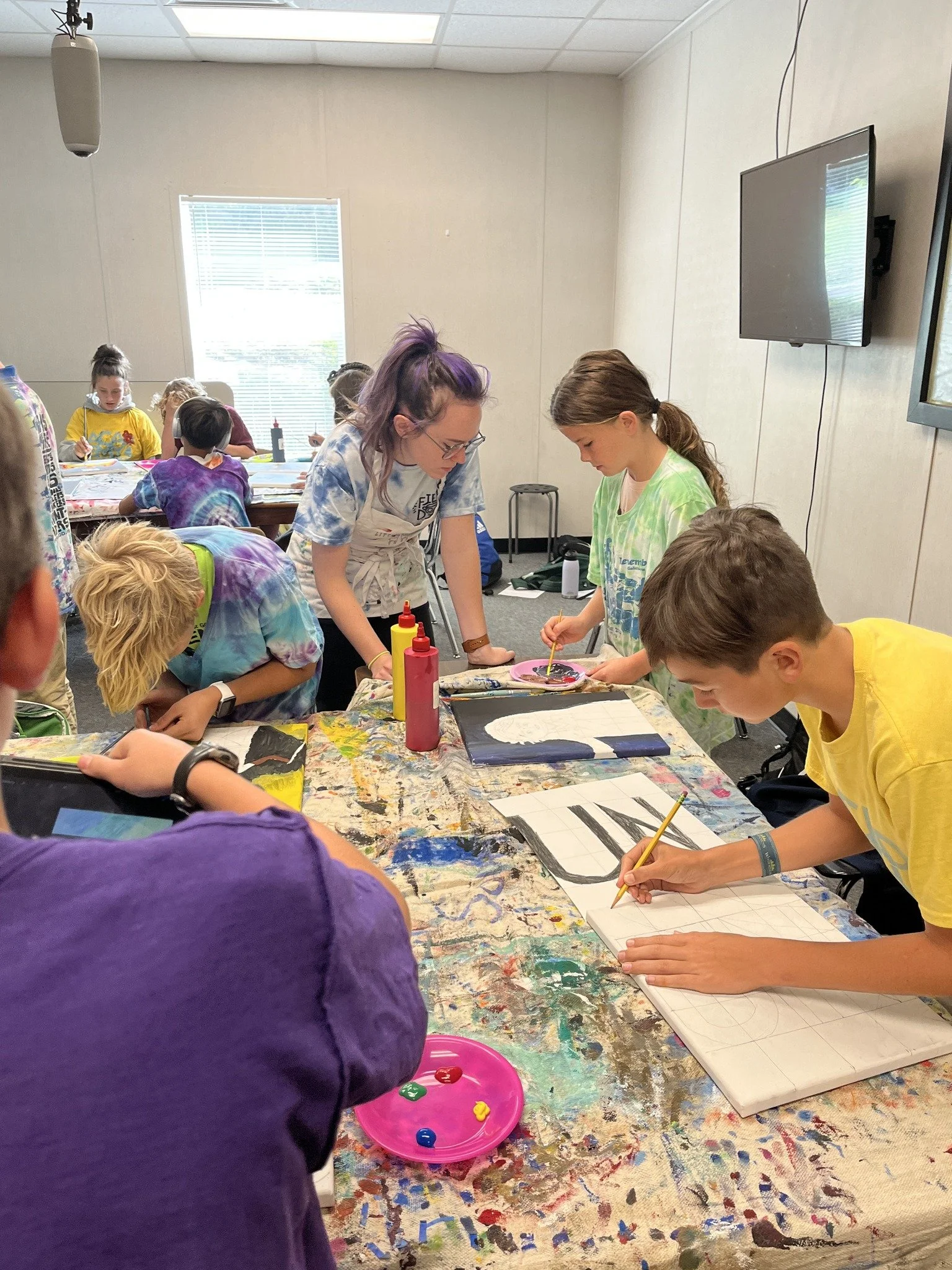
Natania, a senior at the Academy, joins us for a portion of each art class for her Teaching Practicum course. This course is designed to give seniors practical skills related to teaching concepts to younger students. She is learning to communicate with students in a way that effectively helps them think through visual art processes and encourages them towards good work. She is pictured above helping a student talk through the process of making a brown paint color for the skin tone of a girl from India. It's been a blessing to have her join us.
These words are profound for a few reasons. First, teens today are faced with all kinds of social media that promotes fast paced pressure for them to have an appearance that they have things figured out. This prayer directly opposes what the culture they are living in demands and instead, sticks closely to God’s hopes for them. Second, our values here at the Academy resonated in this student’s prayer. She not only acknowledged herself and her classmates as students, but took the humble position that they are in need of continued growth because they are learning. Finally, she acknowledged that this would take patience and isn’t something that can be faked (James 1:22).
To make God proud (Law #3 - Exodus 20:7), these students are implementing what it looks like to uphold God’s reputation. They are learning to recognize that their efforts to become effective problem solvers can only come from God’s presence in their life, their knowledge of the word of God, and their ability to walk it out in obedience. Their hard work and faithfulness to the tasks and projects given to them is a sign of their obedience.
After the class collectively said “Amen,” I was able to encourage the students that learning to be effective problem solvers according to God’s word is a lifelong practice. The adults around them engage in problem solving every day and we are prayerful in our considerations along these lines as well. I pray that they can continue to hold this type of reliance on the Lord as they are becoming the people that God needs in the world.
After this wonderful moment, students dove into their art workshop developing class murals. Their first quarter project is to collectively create a mural that expresses a value that they chose from God’s word that has been highlighted during their time at the Academy. One group chose the theme of “Unity” with an emphasis on people from around the world working together. The other group chose the theme “Rise Up” and are working through the resurrection motif that comes with our school's mascot, the Phoenix.
Students are engaging in higher order thinking skills related to creating artwork that communicates a theme or concept based on their knowledge and ability to apply and analyze it. This project has required students to problem solve with measurement (more math than they would have imagined fitting into an art class), color mixing, and painting. Students are also engaging their SEL skills of teamwork and communication to effectively problem solve their project as a team. I’m seeing wonderful fruit during this first quarter of Jr. High!