




Applying Theology to Graphic Design
8th Grade Graphic Design students learn from a local artist and designer how to create in light of the bible teaching they’ve received. Read about how this application transformed into a really cool project!

This semester, 8th-grade students have had the opportunity to take “Intro to Graphic Design” with Mrs. Milliron, a local graphic designer with Genovations Media, who has taught with the Academy on a number of occasions. She brings her expertise to the classroom and encourages students to make conscious decisions about their visual efforts because design must be intentional. At the start of this course, Mrs. Milliron taught the students to consider their position as creative beings, created in the image of God. She exhorted them from the Word, helping them to understand why labeling and design matters. The following verses have been the foundation of all the work that students have put in this semester:
It allows us to properly label and bring order (and life) to our environment (Genesis 1).
It is a part of how we represent ourselves, and reputation is important (1 Peter 2:12).
It’s a way we can show hospitality to others, by helping them be represented well, too (Galatians 6:9-10).
Students have been challenged to work with multiple design programs requiring their own drawing skills while also learning tools to enhance their work as well. They have learned about the elements of design, principles of graphic design, color theory, color psychology, typography, layout, and composition.
With all of these foundational skills in order, students were able to move forward by engaging in logo design for “Flamingo Airlines”, a fictional company, where they had to take the results of a creative brief and work through the steps of brand creation, including, research, brainstorm, conceptualization, refine, and finalize. When this process was finished after several weeks, the students had the opportunity to vote for their favorite final Flamingo Airlines logo among their peers. The winners were Caleb Lasater (3rd), Jonah Willis (2nd), and Sarieli Reyes (1st). See the pictures below for their logo mock-ups on airplanes!
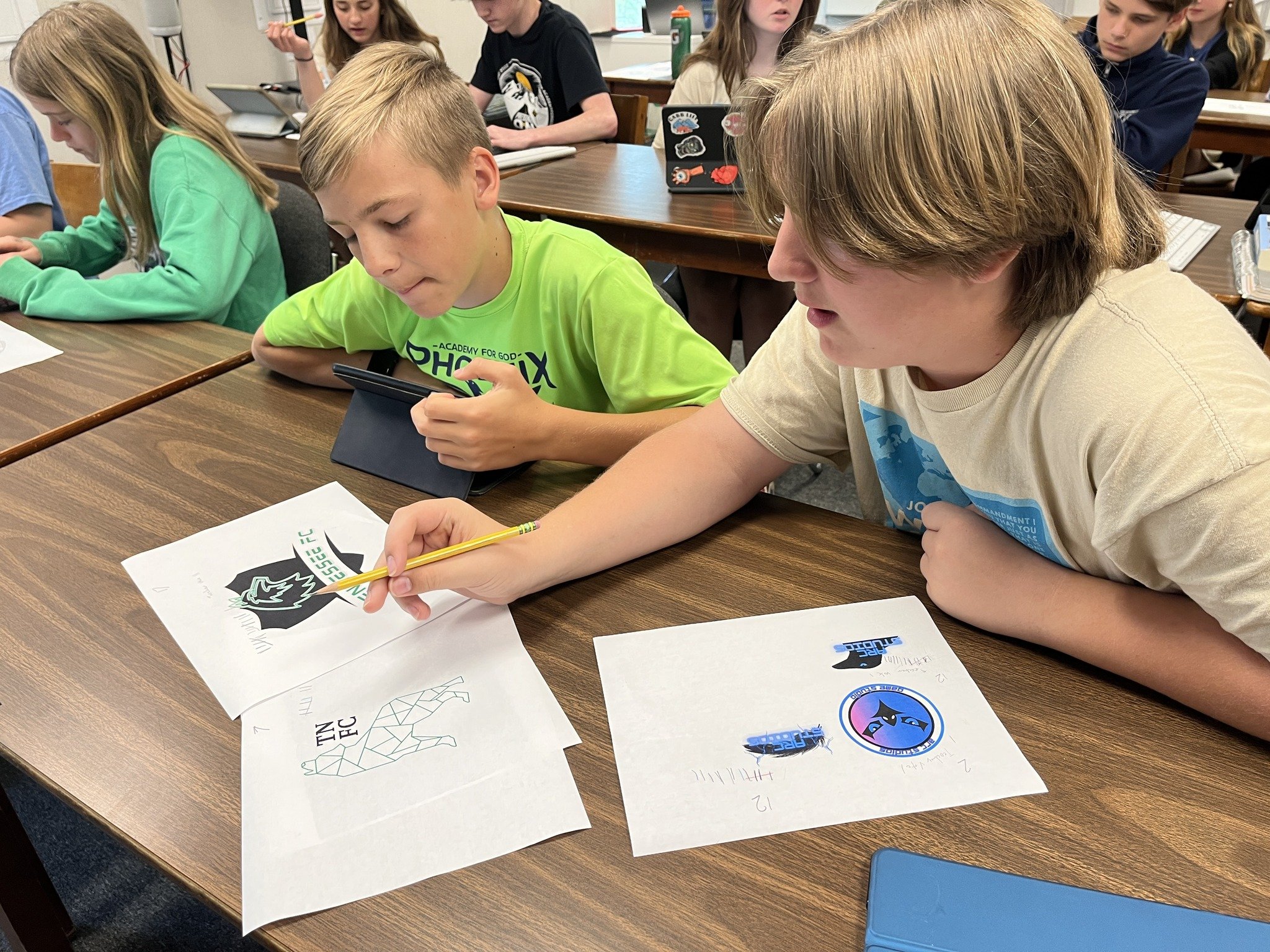
After the Flamingo Airlines project, students then moved into the final project of the semester, creating their own businesses! Students have worked diligently over the past few weeks to design a logo in multiple forms, create business cards, flyers, and various collateral. They have also done the hard work of giving each other constructive feedback. They will end the semester with a networking event where they will showcase their businesses to other classes and teachers throughout the school.
The students have done an excellent job making consideration for the Word of God and those they intend to serve with their businesses. Some students have thought very practically about things they can do now, like babysitting, home organization, and guitar lessons. In contrast, others have thought about their future selves and the type of work they would like to get involved in like healthcare, counseling, sports companies for youth, healthy snacks for athletes, and many more. It's been a blessing to witness their future dreams through this project!
Thank you, Mrs. Milliron, for this wonderful introduction to graphic design for our students!






School Lunch Hero Day!
It’s School Lunch Hero Day, and we’re proud to honor Mr. Reyes for his faithful service as part of the Academy meal program team!
On May 5th we celebrate School Lunch Hero Day! School Lunch Hero day was started in 2013 by the School Nutrition Association. It is a way to celebrate those who make meals possible to students all across America!
Every day at the Academy we have a host of different people involved in ensuring our meals take place. Lunch Hero Day is a special day to recognize those who are involved in this process. We also love to highlight that we have a wonderful staff that includes both parents and grandparents and siblings of Academy students. Our students love seeing familiar faces of their family members in the cafeteria and we think it makes meal time extra special!
For this Lunch Hero Day we are proud to honor Mr. Reyes who has been with the Academy meal program since 2017. He has 20+ years experience as both a chef and working in food service. Mr. Reyes manages the daily meal service and ensures all our workers and students have a fantastic experience. Even through the pandemic Mr. Reyes continued to work tirelessly, delivering meals to families in our neighborhood. He helped facilitate almost 6,000 meals to our community during that time. It was no small feat!
If you visit our cafeteria, you may even catch Mr. Reyes greeting students in Spanish and helping them work on their Spanish salutations. We are so thankful for the years Mr. Reyes has dedicated to meals for our students. He is not only a fantastic chef but he strives to ensure everyone has the best quality service possible!
May God bless you for your service, Señor Reyes. You are a true School Lunch Hero! ¡Muchas Gracias!


Tools to Help Children Handle Anxiety
Academy social worker, Ms. Liz Kalama-Kagay, LMSW, reflects on a training put on by the same counselors who have been helping families from the Covenant School move through their tragic experience. Read her thoughts on helping children deal with anxiety.
My name is Liz Kalama-Kagay, LMSW, and I work as the licensed school social worker at the Academy. I recently attended a training put on by the same counselors who have been helping families from the Covenant School move through their tragic experience.
Sissy Goff is a LPC from Daystar Ministries Counseling, and David Thomas, a LMSW who works with kids and families in counseling. The seminar at Christ the King school was geared towards helping parents raise worry-free children. A study by JAMA Pediatric showed that one in five youth worldwide now struggle with anxiety symptoms. This is not limited to teens; according to Mental Health of America, the average age of a child being diagnosed with anxiety is 6 years old. Sissy and David spent the evening educating the audience on what anxiety is, effective tools to help students name it, and grounding exercises to address it.

This year I had the opportunity to teach SEL lessons to our Ugandan International students. We discussed the coping skills we use to weather the storms that life throws at us, in a way that we can find the peace that the LORD promises.
The scripture they shared was John 16:33, “I have told you these things, so that in me you may have peace. In this world you will have trouble. But take heart! I have overcome the world.” According to Ms. Goff, simply put, "anxiety is an overestimation of a problem." We learn from the Bible that anxiety is something that we all will contend with in this life, however the way we deal with it matters. We do not have to be overcome by it.
Children present with anxiety on a continuum from ‘exploders’ to ‘imploders’. Exploders tend to be boys who will act out angrily and aggressively when feeling anxiety. Imploders (typically girls) tend to internalize the anxiety. They try to be perfectionists and instead report more somatic symptoms like headaches, stomach aches and other physical ailments. If you can view all behavior as communication, you can help your child recognize when they are feeling anxiety. Then you can then help them to develop the coping skills necessary to face their anxiety rather than just try to manage it. Some valuable tools are Box Breathing, 5-4-3-2-1, and Naming a Color.
These are all very effective tools for helping the brain and body respond in a more helpful manner during an episode of anxiety. When a child is feeling big emotions like anxiety, their brain shifts into survival mode. Their body sends more blood to their bigger muscles and their heart starts beating faster as a way for them to prepare to fight or run away. However, our brains can be tricked to respond in a survival manner when there isn't a reason for that response. Therefore grounding exercises are very helpful in getting your brain to turn back on rationally, and think and reason through a situation. (see Dan Siegel on how the brain reacts to anxiety)
Another tool the presenters offered as a way to deal with anxiety is to help students increase their emotional vocabulary. Children need to develop appropriate language to express themselves. The last tool was giving the students the opportunity to make social connections - essentially to learn how to have strong relationships.

I was so happy to reflect on how Academy students are being taught all of these SEL skills on a daily basis. Each morning in Beginnings class, Academy students get a theme to help root them in biblical perspectives on how to be a friend, how to maintain peace, and how to deal with conflict. Their classes help them with a developed vocabulary and they have learned about their brain and how to address emotions with breathing and grounding exercises.
Anxiety is real. In life we will be hit with different challenges and we will respond emotionally. However, we do not have to let anxiety rule us. The way we walk through challenges should be different because we know God. He's given us each other and he’s given us his Word.
There are many scriptures that address this concept but I really like Philippians 4:4-7 in that it starts with a reminder to rejoice.
“Rejoice in the Lord always. I will say it again: Rejoice! Let your gentleness be evident to everyone. The Lord is near.
Do not be anxious about anything, but in every situation, by prayer and petition, with thanksgiving, present your requests to God. And the peace of God, which transcends all understanding, will guard your hearts and your minds in Christ Jesus.”
When we are anxious it can be very challenging to see or feel anything other than our moment. This scripture is helpful because it makes us pause; grounding exercises make us pause. They allow us to connect with our very real human bodies and breathe. This verse starts with rejoicing, which is a tool to help us remember. We must reflect on what is going well, which helps us reframe our moment.
This text goes on to communicate that we are engaged in relationships which is also a helpful tool in dealing with anxiety. When I am alone in my anxiety it can feel overwhelming but when I pause, take time to breathe, take time to rejoice and then take time to ‘let my gentleness be known to EVERYONE’, I know I have to engage in social relationships. I have to put myself near another person and together we can deal with my anxiety. Kids need to learn how to communicate this need and reach out to others. They need to know they are not alone, and the gift we have in a community of faith is that we don't have to walk through any storm alone.
Finally, the text continues to say with "prayer", making your requests known to God and God will give you peace. Peace is the opposite of anxiety, and our LORD promises that to us.
In attending this seminar it was helpful to hear that what our students are getting throughout their education at The Academy is the best practice to help them navigate the inevitable storms that life throws at them. I hope these tips are helpful for parents and educators, in equipping our kids and helping them to walk in peace.

Ugandan Home Education Exemplar Testifies to Confidence
Academy Home Education Exemplar, Victor Lubega, shares about a rewarding experience learning a new skill.
Victor Lubega, a 9th grade student in Uganda, was recently awarded Exemplar of the Quarter for the Home Education Program! Victor has been an outstanding student; taking initiative with his teachers, and approaching each class with joy and a strong work ethic.

Victor met twice with Academy staff during this process, and emailed back and forth throughout. From class assignments to awards like this project, Academy education incorporates soft skills like problem-solving and communication.
For Exemplar students who are international, we award them an online coaching session in a subject of their choice. Victor let us know that he had been curious to learn about building with cement. He had explored some cement work on his own, but asked for help in learning how to work with cement and create useful and beautiful objects. Academy teacher and parent Joel Olson volunteered to coach Victor through this project!
Over the course of 2 weeks Victor learned to work with a sand mold, and used some of the large, beautiful leaves available to him at home to create a cement caste leaf! Such artistic casted leaves can be both aesthetic and functional in a home garden, serving as a bird bath and attracting pollinators. Victor worked carefully with the leaves, learning the ratios of mixing cement, and making creative repairs along the way when a delicate leaf ripped or part of the cement chipped off. At the end of the project he joined Mr. Olson and AHE Vice Principal Hjalmeby on a call to show off his finished project!
When asked what he learned through his project Victor said. “Being confident. I didn’t think that I could do this project, but I gained confidence and I did it well. I also learned that building good things can bring joy to others. I did this project and I showed it to my community.” He also shared about resourcefulness, and how it did not require fancy measuring tools to create something. His entire project cost about $7.95 USD.
Throughout this project Victor displayed the same eagerness and ingenuity that he has shown in all his classes. “Victor impressed me from the very beginning.” said Mr. Olson, “His desire to learn such a practical skill coupled with his ability to implement the instructions really blessed me. This project allowed me to see Victor’s heart. He is going to be a real blessing to his family and his community.”


Sand mold - A sand mold gives structure to the leaf, so the natural shape and veins can be captured in cement. It is an economic way of casting cement and pairs beautifully with natural resources.
Mixing Cement - Victor learned the 3-2-1 ratio of mixing gravel, sand and cement. This rule of thumb means the mixer doesn't have to have extensive equipment for weighing or measuring, but can use simple cups and scoops readily available to them.
Finished Leaf - Victor was as proud of his project as we were of him! Victor is already planning his next cement caste and promises to send us pictures soon.

Can Enough Sleep Really Improve Grades?
While we may sometimes complain about teenagers being lazy and sleeping too much, studies reveal how important sleep actually is for optimal brain function.
To wake up or sleep in? That is the question. Of course, if your teenage student has class, they better not be sleeping in too late. However, you should be making sure they are getting enough sleep, as research shows it can make a big difference in classroom performance. Lack of sleep contributes to poor concentration, which is an essential component if one expects to excel academically.
While we may sometimes complain about teenagers being lazy and sleeping too much, studies reveal how important sleep actually is for optimal brain function. After all, the brain of a teenager is still developing. In fact, it typically doesn’t even reach full maturity until the mid-twenties. Thus, sleep for teenagers is not just for their growing bodies, but also for their developing brain. Sleep deprivation is a hindrance to healthy brain development and could potentially be a contributing factor if you notice a decline in your teen’s academic performance.

In 2023, the Sleep Foundation found that later school start times support the biological needs of adolescents; they increase the amount of sleep adolescents get. Other benefits of later start times include: improved attendance at school, decreased tardiness, fewer occurrences of falling asleep in class, reduced irritability and depressive symptoms and fewer disciplinary issues.
Studies have shown the sleep patterns of teenagers differ from children and adults, and in most cases, they need more than those who are in other stages of life. Also, when it comes to sleep, teenagers experience phase delays which cause them to more easily stay up later than younger kids or adults. The levels of the sleep hormone melatonin usually don’t decline until later in the morning as well, which goes to explain why they may sleep later.
It can be difficult to make sure a teenager gets enough sleep, but with too little sleep, it could negatively impact a student’s grades. Whether it’s implementing bedtimes or curfews, making sure gadgets are turned off a while before going to bed, or developing a “pre-sleep” routine to help your body prepare for resting, there are rules we can try to teach our teenagers to implement to ensure they are sleeping enough. Cognitive function, attentiveness, and memory are improved by getting enough rest, and it has the possibility to significantly help their classroom performance. For more information on this topic, check out some of the sources below:
Sources:
“The Teen Brain: 7 Things to Know.” National Institute of Mental Health.
Sifferlin, Alexandra. “Why Teenage Brains Are So Hard to Understand.” Time. 8 September 2017 (visited 15 September 2022).
https://time.com/4929170/inside-teen-teenage-brain/
“Poor sleep can negatively affect a student’s grades, increase the odds of emotional and behavioral disturbance.” American Academy of Sleep Medicine. Updated 7 Nov. 2017 (visited: 5 Sept. 2022)
“Sleep and Health.” Centers for Disease Control and Prevention. Reviewed 29 May 2019 (visited 5 Sept. 2022)
Walton, Alice G. “7 Ways Sleep Affects The Brain (And What Happens If It Doesn't Get Enough). Forbes. Visited: 16 September 2022.
Okano, K., Kaczmarzyk, J.R., Dave, N. et al. Sleep quality, duration, and consistency are associated with better academic performance in college students. npj Sci. Learn. 4, 16 (2019). Published 1 October 2019 (visited 5 September 2022). https://doi.org/10.1038/s41539-019-0055-z
https://www.nature.com/articles/s41539-019-0055-z
Merriman, Kate. “School performance can be improved with a good night’s sleep.” WMBF News. 19 Feb. 2021 (visited: 5 September 2022)
https://www.wmbfnews.com/2021/02/19/school-performance-can-be-improved-with-good-nights-sleep/
Suni, Eric. “How Lack of Sleep Impacts Cognitive Performance and Focus.” Sleep Foundation. Updated 29 April 2022 (visited 5 September 2022)
https://www.sleepfoundation.org/sleep-deprivation/lack-of-sleep-and-cognitive-impairment
Locker, Melissa. “Let Your Kids Sleep More For Better Grades.” Time. 13 January 2015 (visited 5 September 2022).
https://time.com/3663796/for-better-grades-let-your-kids-sleep-more/