



Why Curriculum Matters
Recently the Academy administration announced the incorporation of several new (to us) instructional programs. These resources like UFLI, JumpMath, and Phonics for Reading focus especially on teaching math and language arts skills at the K-8 levels, to ensure the strongest possible foundation for our students. We wanted to take a moment to share the value of clear, well-researched and tested knowledge building programs, and all that it will add to a student's education. Not only do such comprehensive curriculums safeguard against students ‘slipping through the cracks’, but it frees the teacher to focus not on lesson creation but on the students: on the instructional delivery. This aligns with our long-standing value that it is our teachers who are the most valuable part of the classroom.
The importance of curriculum, a clear and coherent plan for learning over time, is difficult to overstate. You can’t teach if you don’t have something to teach about (curricular knowledge), you don’t know how to teach (instructional methodology) until you know what has been taught (prior knowledge). In more simple terms, instruction is blind and aimless if the curriculum is broken, absent, or fragmented. Nuno Crato(1), leader of Portugal's successful educational reforms, says “Everything starts with the curriculum. This is the education founding document and without clear learning goals no education system can progress.” (2) A school exists to transmit critical content, information, knowledge, and skills to the next generation—content that would not be acquired as efficiently through natural discovery alone. The curriculum sits at the heart of the school, and if it is not centrally understood, accessible, and shared by all—as Crato emphasizes—don’t expect progress. If schools digress or stagnate, what becomes of society?
Many schools depend on teachers, implicitly or explicitly, to not only generate or self-select curriculum, but to also deliver the instruction. Between and after classes, and through the weekend, teachers nationwide scour Google for lesson plans, assessments, content, printable materials, and activities from sites like Teachers Pay Teachers and Pinterest—resources that may or may not align with grade-level standards or build knowledge coherently.
According to a 2016 RAND teacher survey (3), nearly all teachers (97–99%) reported using self-developed or self-selected materials to some extent—these being the lesson plans, instructional content, activities, and assessments that a coherent adopted curriculum should provide. Weekly or more frequent use was reported by 83% of elementary and 87% of secondary teachers, highlighting the high frequency and near-universal prevalence of teachers acting as de facto curriculum designers.
More recent RAND surveys (4) confirm this pattern persists: nearly half of K–12 teachers use self-created curriculum materials in some capacity, about 25% primarily or exclusively rely on them (termed 'DIY' teachers), and nearly all teachers modify materials extensively—often mixing multiple sources ('cobblers' at 45%). Only about 20% follow a single provided curriculum with limited changes ('by-the-book').
There are a few glaring issues with this. Teachers are rarely trained to design curriculum, let alone trained to use the best evidence informed instructional practices (5). Curriculum design is work that takes extended knowledge of a specific domain in which critical content is identified, lessons are horizontally and vertically sequenced, instructional language is specific and controlled, cognitive load is accounted for, big ideas are constructively aligned from one grade level to the next, and etc. This is done best with teams of experts over the course of extended testing, research, and design. Even after a program is developed, pilot studies must be conducted with preliminary models of logic, feedback has to be collected and quantitative data has to be analyzed. Results have to be accountable to scientifically validated methods like random controlled trials and quasi-experimentation. Large sample sizes of thousands are needed to generate reliable effect sizes. Curriculum teams have to answer the question on whether or not the curriculum works. Robert Pondiscio, author of ‘How the other half learns’ says that making teachers responsible for curriculum design on top of classroom instruction, makes teaching next to impossible to do well (6).
Boards and committees, to no fault of their own, are often underprepared to review curriculum despite great intentions (7). The committees that are formed are not supplied with the available research that has been done to evaluate curriculum. In addition, they do not get enough time away from their classroom responsibilities, or are paid extra for their time to thoroughly inspect/investigate the program in review. The committees are more likely to have questions about engagement rather than factors like measured learning outcomes, methods of instruction, and amount of practice given to students to develop mastery in the subject matter.
Not all curriculums are equal in design and quality. A poorly designed curriculum that stands on plausibility alone can do serious harm to student learning. One can look at the tragedy of whole language learning designed by Lucy Calkins, whose popular but incorrect reading instruction filled curriculums nationwide via major publishers. Many cite these flawed curriculums as primarily responsible for reading declines across the nation (8). Though the curriculums were not backed by sound research nor did it have evidence of being effective, it was continually promoted in the colleges of education without evaluation. Follow the work of education advocate Brett Tingly, or the recent developments in reading outcomes in Mississippi to learn more about what seems to be a closing chapter on the reading wars and reading curriculum.
Though not widely known in the US, the work of E.D. Hirsch Jr, on returning curriculum to knowledge building was a driving feature of the positive results on student learning in the UK. Knowledge building means that content is broken down and arranged into well organized chunks in which students can acquire, practice, and generalize with mastery. That all learning is built on prior learning, meaning that it is the responsibility of the curriculum to have secured what will become a pre-requisite in the future. When curriculum aligns with the learning sciences, we see improvements in equity, creativity, and generalized intelligence. Nations that have risen to the top of the PISA tables share a commonality with regard to curricular design. They are centralized, knowledge building, instructionally explicit, prioritize depth over breadth, and are mastery based.
The improvements in curricular programming have been birthed out of this growing awareness. At the Academy, we will be utilizing programs that have been carefully designed, backed by strong research, tested and seen to have evidence of efficacy, consider learning sciences and the building nature of knowledge, and are supported with strong implementation resources. This has guided the recent selections like UFLI, JumpMath, Arts and Letters, Acadience, Spring Math, and Phonics for Reading. I have linked overviews and evidence for each of these programs on our website. The burden of curriculum for us will not be creation, it will be appropriation, adaptation through collaborative data informed progress monitoring, continuous implementation support, professional training, and assessment.
When schools adopt high-quality instructional programs or curricula that are shared and understood by all teachers, students gain from consistent language, logical sequencing and cumulative knowledge-building, ample deliberate practice, and teachers' greater attention to each student's learning progress. Though curriculum is not the panacea, it is a foundational and unifying component that schools need in their endless pursuit of deeper, more effective student learning.
(1) Nuno Crato is a Research Professor of Mathematics and Statistics at ISEG, University of Lisbon, and served as Portugal's Minister of Education and Science from 2011 to 2015. During his tenure, he led evidence-based reforms—including a strengthened, knowledge-focused curriculum, increased mandatory schooling (from 9 to 12 years), rigorous teacher training, regular student assessments, and reduced dropout rates (from ~25% to 13.7%)—that contributed to Portugal achieving its strongest-ever results on international assessments like PISA (exceeding the OECD average for the first time in reading, mathematics, and science) and TIMSS.
(2) Crato, N. (2021) Improving a Country’s Education: PISA 2018 Results in 10 Countries. Springer Nature.
(3) Opfer, V. Darleen, et al. Implementation of K–12 State Standards for Mathematics and English Language Arts and Literacy: Findings from the American Teacher Panel. RAND Corporation, 2016. Research Report RR-1529-1. RAND Corporation, www.rand.org/pubs/research_reports/RR1529-1.html. Accessed [your access date, e.g., 25 Feb. 2026].
(4) Doan, Sy, et al. Teachers’ Use of Instructional Materials from 2019–2024: Trends from the American Instructional Resources Survey. RAND Corporation, 2025. Research Report RR-A134-30. RAND Corporation, www.rand.org/pubs/research_reports/RRA134-30.html. Accessed [your access date, e.g., 25 Feb. 2026].
(5) Surma, T., Vanhees, C., Wils, M., Nijlunsing, J., Crato, N., Hattie, J., Muijs, D., Rata, E., Wiliam, D., & Kirschner, P. A. (2025). Developing a curriculum for deep thinking: The knowledge revival. Springer. https://doi.org/10.1007/978-3-031-74661-1
(6) https://fordhaminstitute.org/national/commentary/failing-design-how-we-make-teaching-too-hard-mere-mortals
(7) Marcy Stein, Carol Stuen, Douglass Carnine, Roger M. Long (2001) Textbook Evaluation and Adoption, Reading & Writing Quarterly, 17:1, 5-23, DOI: 10.1080/105735601455710
(8) National Reading Panel. (2000). Teaching children to read: An evidence-based assessment of the scientific research literature on reading and its implications for reading instruction. National Institute of Child Health and Human Development. https://www.nichd.nih.gov/publications/pubs/nrp/Documents/report.pdf
New School Playground Install Complete
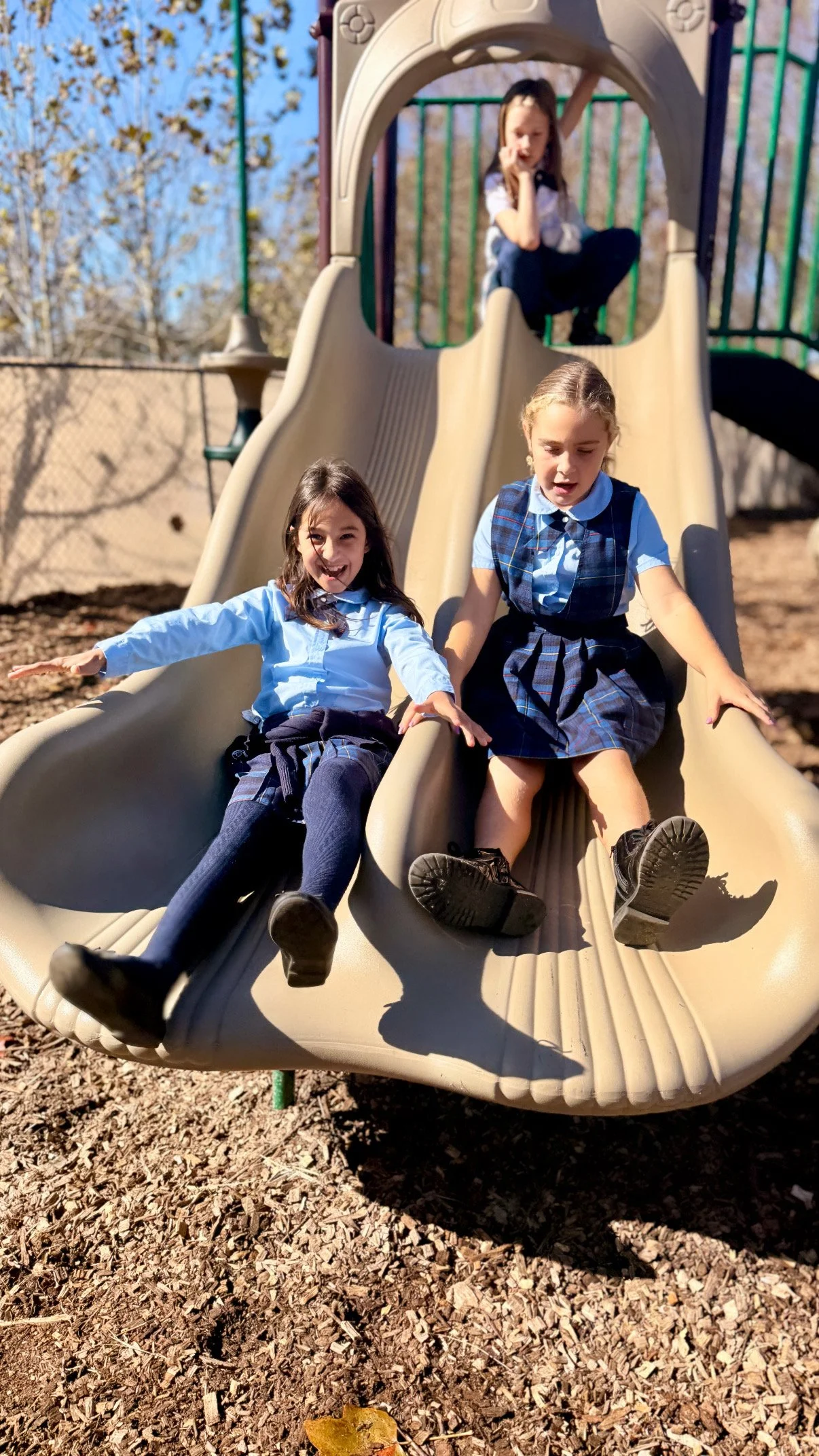
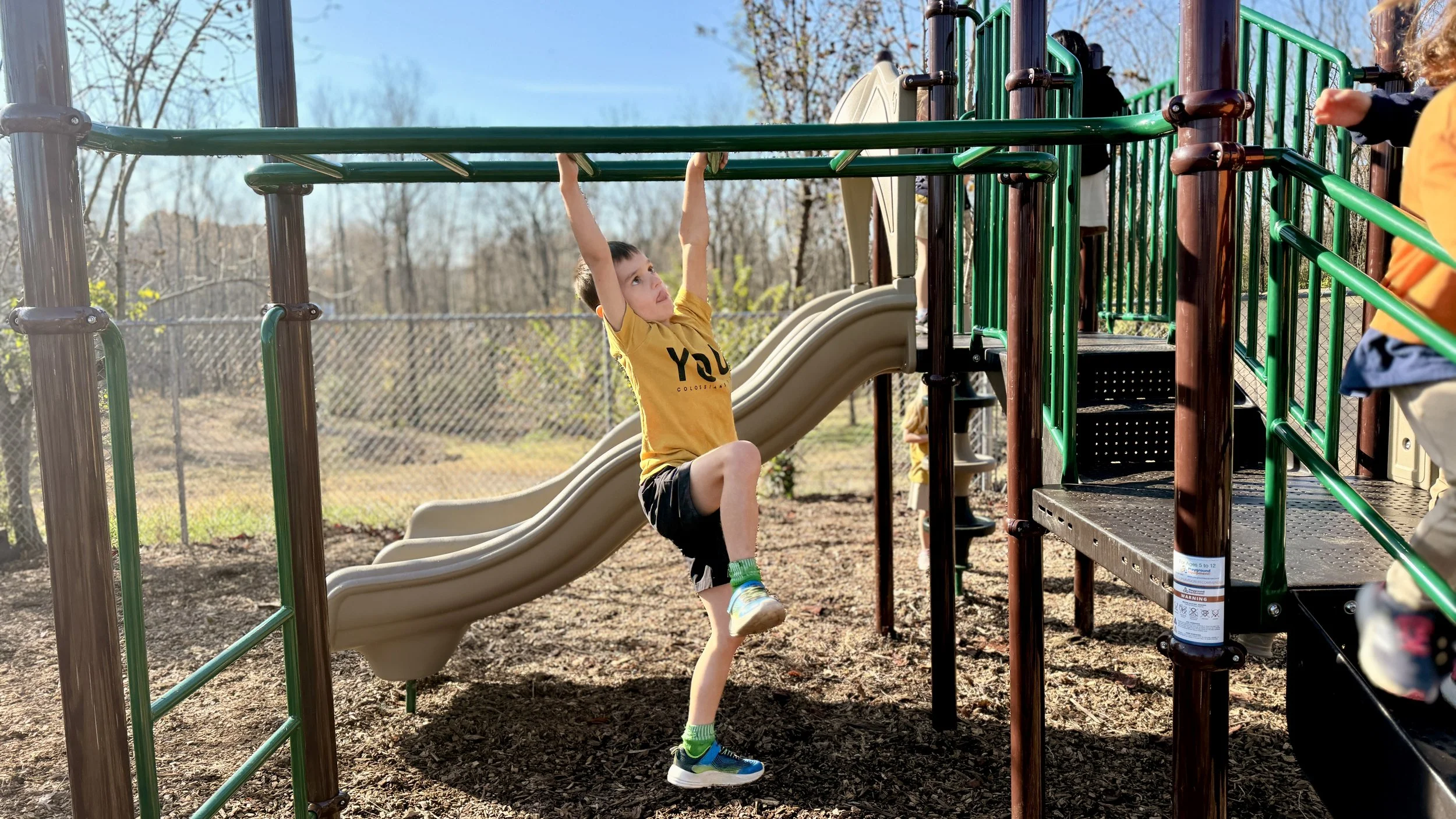
This fall, our Academy campus was enhanced with the addition of a brand-new playground—made possible through the generosity of two Academy parents. Their gift is more than new equipment; it is an investment in our students, our community, and the daily rhythms of learning and play that shape our student’s learning environment.
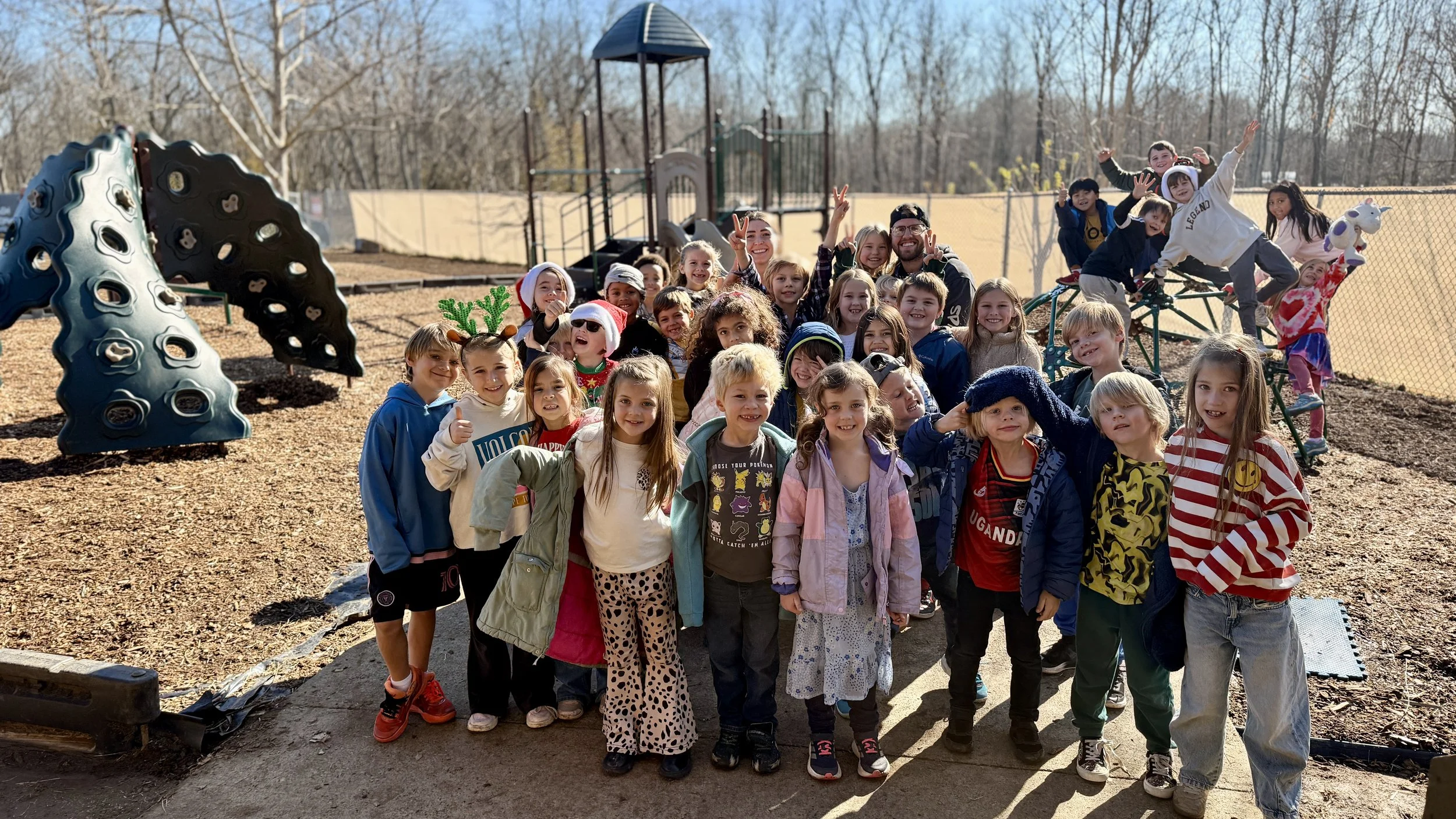
The playground features four pieces from Happy Backyards, a playground company located in Franklin, Tennessee. We are grateful for the opportunity to work with Tom and the entire Happy Backyards install team, whose professionalism, care, and attention to detail helped make this project a reality. From planning to installation, their team ensured the playground was safe, durable, and perfectly suited for our elementary students.
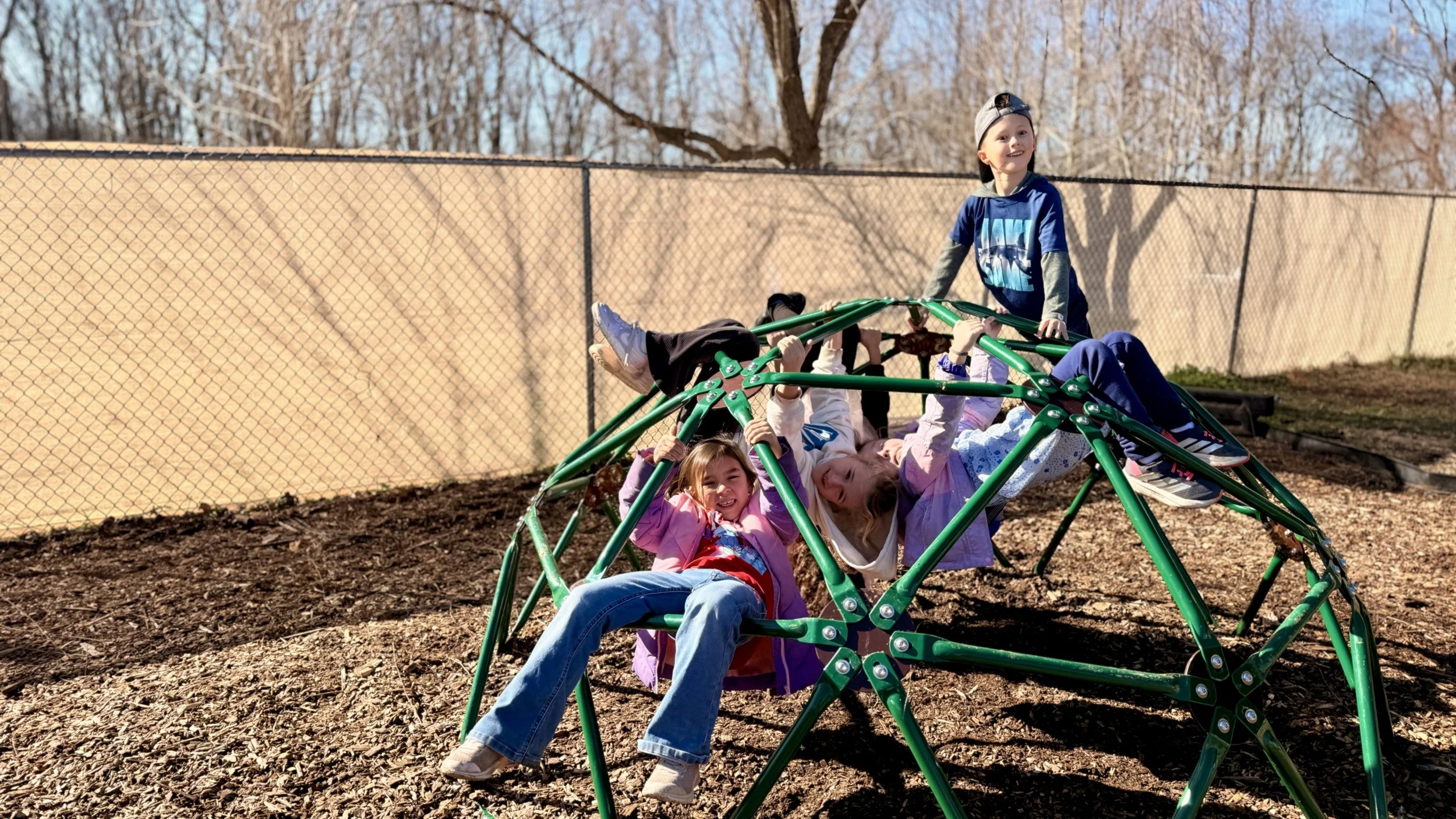
Since its completion, the playground has quickly become a favorite part of the school day. These moments of play are a vital part of learning and development.
Research continues to affirm the importance of recess and playground time for elementary-aged children. According to the American Academy of Pediatrics, regular recess helps improve students’ focus, classroom behavior, and social skills. Studies also show that children are more attentive and productive in the classroom after recess than before it, highlighting the strong connection between physical activity and academic readiness.
Beyond academic benefits, the playground provides daily opportunities for social and emotional growth. Students practice cooperation, communication, problem-solving, and resilience. They learn to take turns, navigate challenges, and include one another—skills that extend far beyond school and into every area of life. These shared experiences help foster confidence, empathy, and a sense of belonging among our students.
We are deeply thankful to the Academy parents whose generosity made this playground possible. Their investment will serve our school for years to come, blessing countless students with opportunities for healthy movement, creativity, and joy. We are also grateful for our partnership with the team at Happy Backyards who brought this vision to life with excellence and care.
We hope this new playground offer students a space to play, grow, and thrive!
Independent Third-Party Investigation Underway with GRACE
The Academy’s Board of Directors have authorized an independent, third-party investigation through GRACE (Godly Response to Abuse in the Christian Environment).
This decision follows the resignation of our founder and former head of school, Gregg Garner, after credible allegations of sexual misconduct involving adult women were reported to leadership.
The choice to engage GRACE was made in consultation with legal counsel and trusted ministry advisors across the nation.
About GRACE
GRACE is highly regarded among Christian ministries for conducting independent investigations and providing recommendations related to abuse prevention, accountability, and organizational health. Their multidisciplinary team includes experts in law, mental health, theology, and ministry leadership. GRACE will provide an independent assessment of the allegations and provide the Institute with recommendations to ensure best practices for responding.
Our Commitment
We believe that truth and accountability are essential to integrity in Christian education. Our leadership is committed to cooperating fully with GRACE throughout this process and to fostering a safe, transparent, and trustworthy environment for learning.
The investigation will take several months and will include opportunities for individuals connected to our ministry/school to share their experiences confidentially. We have provided parent contact information to GRACE for each of our currently enrolled students in order for you to receive an initial survey for participation.
We ask for your prayers—for those who were hurt, for our school community, and for all involved—as we seek healing, clarity, and faithfulness to the mission entrusted to us.
With sincerity,
Stephen Carver,
Chairman of the Board
FAQs
What is GRACE?
GRACE (Godly Response to Abuse in the Christian Environment) is an independent organization that assists Christian institutions in understanding, addressing, and preventing abuse. Their team includes professionals in law, mental health, theology, and ministry. You can learn more about them at netgrace.org
Who oversees the investigation?
The investigation is being conducted solely by GRACE. The boards and leadership of GOD International and The Institute for GOD will not facilitate the investigation itself but will cooperate fully with GRACE’s process and recommendations.
How can someone participate or share information?
Individuals who wish to participate will receive information directly from GRACE regarding how to share experiences confidentially. The process is managed entirely by GRACE to ensure independence and safety for all participants.
What do I do if I have more questions?
Because we are in an investigation period, it would be inappropriate to take questions beyond what we’ve already stated. If you would like to send inquiries or comments regarding participation, please contact our Principal Alex Castro @alex.castro@academyforgod.org.
Why Students Need to Memorize Math Facts
And Why It’s Not “Rote”. It’s Foundational.
According to the NAEP (often called the Nationʼs Report Card), 61% of U.S. 4th graders scored below proficiency in mathematics in 2024. That number rises to 78% by 8th grade. As leaders, educators, and parents, we must be asking the question: What is causing this math crisis?

Over the past two decades there has been a prevalent misconception in many education circles, that memorizing math facts (those simple addition, subtraction, and multiplication facts that we want at our students’ fingertips) isn’t necessary. That students don’t need to know the multiplication table because they can always use other strategies… or just grab a calculator.
Though the solution to the math crisis is not singular, one thing is clear: this philosophy has left our students wildly unprepared. Modern education research is showing us the real story – that students who have memorized their math facts into their long-term memory learn math faster, understand it more deeply, and feel more confident doing it. Memorizing the facts isn’t frivolous busywork, it’s completely foundational to a student’s mathematical competence and long-term success.
The Power of Long-Term Memory
When students learn math (or anything for that matter), that learning starts in the working memory. This is the part of the brain that handles information that is coming from “outside” the learner and must be consciously thought about and processed. The working memory is extremely limited! Once we exceed the limits of 3-5 pieces of information, the cognitive load becomes too heavy and learning does not take place.
In contrast, long-term memory is virtually limitless. It can hold an incredible amount of information, and the more a student has stored there, the easier it is for them to learn new things without being overwhelmed. This is where we want the math facts stored! It becomes an incredible tool that the student can access instantaneously while problem solving. When math facts are stored in long-term memory and can be recalled automatically, they place no additional burden on working memory — the mental workspace where new learning and problem-solving occur — and actually free up cognitive resources, making that learning more effective.
In short, these two memories (working and long-term) work together. The things stored in long-term memory help students think critically, creatively, and effectively about the information that has entered the working memory. When students know their multiplication facts “by heart”, they have more brainpower to attend to the problems in front of them.
Knowing Math Facts Frees Working Memory (and Calculators Don’t)
So, now we know that working memory is like a student’s mental whiteboard. It only has room for a few ideas at a time.
When a student knows that 7×8 = 56 instantly, that fact takes up zero space on the whiteboard because it’s already stored in long-term memory.
But if they have to stop and figure it out (“Let’s see… 7×7 is 49, so 7×8 is 49+7…”) they’ve already used limited brainpower before even tackling the actual problem in front of them.
That’s why knowing these facts is so important. It reduces the cognitive load and frees the brain to focus on complex problem-solving and creative reasoning, the kind we want them doing in algebra, geometry, and beyond (Ding et al., 2019). Automatic recall isn’t about speed for speed’s sake; it’s about accessing higher-level thinking.
But Can’t We Just Give Kids Calculators?
A calculator can’t reduce the entire cognitive load for students. In fact, relying on one adds steps: Using the device, typing correctly, interpreting the result, and deciding whether it makes sense. Each of those eats up more working-memory space and creates new chances for error.
When facts are known, students can reason fluidly. When they’re not, even basic problems can feel like wading through mud. Take the following example: When students have to factor a number in algebra, such as 48, they need to quickly know that all of their options are 4x12, 6x8, 3x16, 2x24, and 1x48. A calculator can help a student find the factor pairs, but it will be much slower, use up a lot of working memory, and the student will not be confident that they have produced all the possible factors without first checking every single number on the calculator, which is extremely cumbersome. When students haven’t committed basic knowledge to long-term memory, their multi-step problem solving remains labored.
Math Is Hierarchical – Facts Are the Bottom Rung for Later Success
Mathematics builds like a staircase. If the lower steps aren’t sturdy, students struggle to climb.
Weak multiplication fact recall hinders students in many topics moving forward:
Fractions: finding least common denominators and simplifying fractions depend on fluent multiplication and division recall.
Algebra: factoring trinomials, expanding binomials, and balancing equations all rely on multiplication fact recall. Like the example mentioned above, students factoring 48 need to quickly know that all of their options are 4x12, 6x8, 3x16, 2x24, and 1x48.
Problem solving: estimating, checking reasonableness, and spotting errors are much harder when you don’t have access to the numbers in long term memory.
In short, multiplication facts are not the destination, they’re the bridge. Without them, higher level math becomes an uphill battle.
But Isn’t Rote Memorization Bad?
You may have heard that rote memorization is bad for learning. That is only true if “rote” means memorizing without meaning or understanding. When we talk about knowing math facts, we are talking about memorizing the facts after the students have gained understanding of what the operation is, and how it works. Once the student has that understanding, they are ready to get those facts stored in their long-term memory through consistent, repeated practice. This isn’t meaningless repetition, it is strengthening of the neural pathways and paving the way for mathematical fluency. It is similar to athletes who create muscle memory after lots of repeated practice with a physical skill.
Bringing it all together
Knowing math facts doesn’t hinder understanding, it enhances it. What used to bog the student down now lets them connect to math concepts confidently, and reason effectively. When it comes down to it, helping students memorize math facts isn’t about drilling them with mindless practice, it’s about giving them access to a powerful tool. A deep well of information they can pull from at a moment’s notice. When the facts are memorized and stored in that long-term memory, students gain the capacity to do robust, complex, mathematical problem-solving.
Citations and resources for further exploration:
Baker, A. T., & Cuevas, G. (2018). The importance of automaticity development in mathematics. Georgia Educational Researcher, 14(2). Retrieved from https://files.eric.ed.gov/fulltext/EJ1194585.pdf
Ding, Y., Li, H., Liu, M., & Zhang, Q. (2019). Effects of working memory, strategy use, and single-step mental addition skills on multi-step mental addition. Frontiers in Psychology. https://doi.org/10.3389/fpsyg.2019.00148
An introduction to cognitive load theory - THE EDUCATION HUB
Written by Janae Castro

God is Able: Help Us Extend Academy Education Across Borders

This is a very special year for the Academy Remote Learning program: five of our students are graduating with us in the spring! Some of these students have been with us since the start of this program. We wanted to highlight one of these students in particular, to help show the good fruit that is coming from the education these youth are receiving.
Victor Lubega is a young man who has excelled through the Academy Remote Learning program. His teachers all know him to be enthusiastic, communicative and hard working. He has received Exemplary Student awards several times in his years with us.
One practical benefit of being with our program is that it has allowed Victor to remain close to his family through his teenage years. Students who attend local schools in Uganda are often gone for 9-10 hours a day. This increases at the secondary school level; they might be gone from 6:00am to 10:00pm at night! This is an incredibly taxing system that keeps them away from parents. Our cooperatives in East Africa have expressed many times how grateful they are to have their children near them, to be able to look out for them and invest in them as they are getting their education remotely.
Another benefit of this Academy program is that Victor will graduate with strong literacy skills. Previous graduates from the Remote Learning program have entered the Institute for GOD college, and have a huge advantage compared to their peers who attended local schools in Uganda. They know how to critically engage literature, organize their thoughts into essays, and write clearly with strong grammar. As people of scripture, we know how important it is to be able to engage the written Word. It is a key part of human development, enabling us to image God as He intended.
Finally, Victor has been able to pursue his interest in electrical engineering, and get practical experience in this career field. This year he is completing his senior internship with Community Works, a program of GOD Int’l that focuses on infrastructure development in the 3rd world. With Community Works manager James Lasater supervising him remotely, Victor was able to work with an older mentor on the ground on several projects this semester. The first was to install solar energy systems to every house on the GOD Int’l campus, enabling personnel there to access power even when the local electricity goes out. This kind of career jumpstart is something we’ve been able to offer our students both locally here in Nashville and abroad. It saves time and money after graduation for young people like Victor who are determining a career path. Victor now has practical experience in the field of solar energy, and a confidence that he would like to continue down the path of an electrician.
There are so many wonderful things happening in the lives of our remote students. But we do have some very practical needs remaining for this year. At the beginning of the school year we received some generous donations that helped cover a portion of student scholarships, yet there is a remaining need of $17,950. This covers tuition, technology access and academic support to our students in Uganda and Morristown. It would relieve parents from shouldering the burden of this year’s school fees alone. Would you consider investing into the lives of these young men and women? Join us in offering them a safe and nurturing school environment, and putting them on a path for a bright future.